Blog
- Home
- Blog
2026 Best Working Valve Types for Industrial Buyers
Industrial buyers in 2026 need valves that match real operating conditions, not just a line on a specification sheet. A working valve must control flow reliably under the system’s pressure, temperature, fluid, and duty cycle. Those requirements can vary widely between a steam line, a cooling-water loop, and a chemical dosing skid. Small details matter. Seat materials, connection style, actuator response, and maintenance access can all affect performance over time.
This guide introduces common industrial valve types, including ball, gate, globe, butterfly, check, and control valves. It explains where each design may fit, what trade-offs buyers should examine, and which questions to raise with suppliers. A compact ball valve may suit frequent isolation, while a globe valve can offer more precise throttling in suitable service. Neither choice is universal. A technically sound comparison should consider pressure drop, leakage expectations, installation space, spare parts, and the consequences of downtime. We also highlight the limits of general guidance: actual suitability depends on the process data and the manufacturer’s documented ratings. That can feel less convenient than choosing by price alone, but it helps prevent costly mismatches. Use the sections ahead to build a shortlist, verify critical specifications, and make a more informed purchasing decision.
What Industrial Valves Do and How They Work
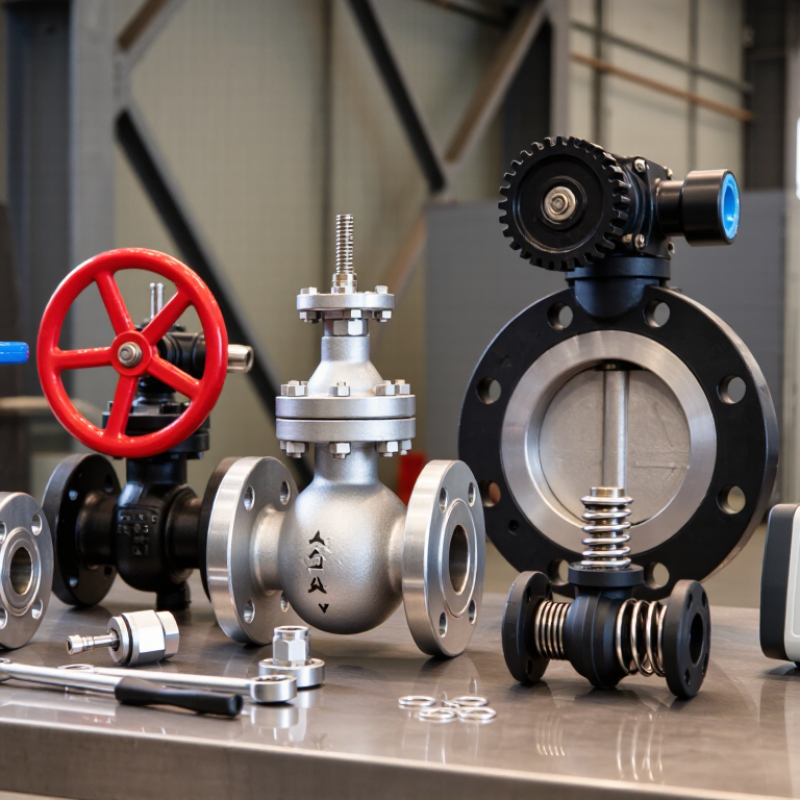
Industrial valves direct, isolate, regulate, or stop flow through pipes. Their job sounds simple. The details matter. A gate valve lifts a barrier from the flow path, making it useful for on-off service. A ball valve turns a bored sphere one quarter-turn to open or close the line. Globe valves move a plug toward or away from a seat, allowing finer flow adjustment, while check valves use flow pressure to limit reverse movement.
Actuated control valves add another layer. An electric, pneumatic, or hydraulic actuator moves the valve in response to a signal, helping maintain a target flow, pressure, or temperature. Operators still need to match valve type, material, pressure rating, and fluid conditions to the system. The U.S. Department of Energy’s Improving Pumping System Performance sourcebook estimates that pumping systems use nearly 20% of global electricity, and 25–50% of energy in some industrial plant operations. That makes avoidable pressure losses worth examining.
A valve is not a perfect switch. Partly closing the wrong valve can create turbulence, noise, wear, or excess energy use. In the field, a small leak at a seat may be harder to spot than a clear failure. Good selection starts with the actual duty: isolation, throttling, backflow prevention, or emergency shutoff. Then check how the valve behaves at the expected flow—not just its nominal pipe size.
How Valve Types Differ by Motion and Flow Control
2026 Best Working Valve Types for Industrial Buyers
How Valve Types Differ by Motion and Flow Control
Valve choice starts with motion. A globe valve moves a plug linearly, giving operators finer throttling control. Gate valves also move linearly, but usually serve better as on-off devices than frequent flow regulators. Ball and butterfly valves rotate a quarter-turn, so they open quickly and suit compact piping. Diaphragm valves use a flexible membrane, which can isolate fluid from moving parts. Different motion, different job.
Flow control matters beyond the valve body. The U.S. Department of Energy’s Improving Steam System Performance: A Sourcebook for Industry estimates steam systems account for about 30% of industrial energy use. Poorly matched valves can contribute to pressure loss, unstable control, or avoidable maintenance. That distinction sounds tidy; real piping rarely is. Fluid viscosity, solids, temperature, and actuator response can change the best choice. A control valve sized only from nominal pipe diameter may behave poorly at low demand.
Tips: For modulating service, check the operating range and valve characteristic, not just the connection size. For isolation, confirm the required shutoff performance and cycle frequency. Ask for flow and pressure data from actual operating conditions. A small test can reveal a lot. Even experienced teams sometimes overvalue a familiar design; record why the selected motion suits the process, then revisit that assumption after commissioning.
2026 Best Working Valve Types for Industrial Buyers - How Valve Types Differ by Motion and Flow Control
| Valve type | Operating motion | How it controls flow | Typical strengths | Common uses and selection notes |
|---|---|---|---|---|
| Gate | Linear: a gate moves up or down across the flow path. | Primarily on/off isolation; when fully open, the gate retracts from the main flow path. Not generally suited to routine throttling. | Low flow obstruction and relatively low pressure loss when fully open. | Common in water, utility, and process piping where infrequent isolation is needed. Allow room for stem travel and avoid using it as a control valve. |
| Globe | Linear: a plug moves toward or away from a seat. | Changes the opening between the plug and seat, making it well suited to throttling and frequent flow adjustment. | Good controllability and shutoff capability; trim can be selected for different control characteristics. | Used for process flow regulation and control-valve duties. Its flow path typically creates more pressure loss than a fully open gate or ball valve. |
| Ball | Rotary: a quarter-turn rotates a bored ball. | A standard full-port or reduced-port ball valve is mainly an on/off valve. Characterized or V-port designs can provide modulating control. | Fast operation, compact quarter-turn actuation, and tight shutoff in suitable designs. | Widely used for process isolation and utility service. Check the design and operating conditions before using a standard ball valve for throttling. |
| Butterfly | Rotary: a quarter-turn rotates a disc within the pipe. | Disc position varies the available flow area; suitable designs can be used for throttling as well as isolation. | Compact face-to-face dimensions, relatively low weight, and practical operation in large pipe sizes. | Common in water, HVAC, and many industrial services. Confirm pressure, temperature, shutoff, and control requirements for the selected seat and disc design. |
| Plug | Rotary: a plug turns, commonly through a quarter-turn, to align or restrict its port. | Often used for on/off service; some port shapes and designs support flow regulation. | Simple rotary operation and a direct flow path in many designs. | Used in process and utility piping, including some services with solids. Suitability depends on plug design, sealing arrangement, and fluid conditions. |
| Diaphragm | Linear: an actuator moves a flexible diaphragm against a weir or onto a seat. | Controls flow by changing the passage opening; available in isolation and control-oriented designs. | The diaphragm separates the process fluid from the operating mechanism, which can be useful for corrosive or contaminated fluids. | Used in chemical, water-treatment, and hygienic services. Diaphragm material and design set important limits on temperature, pressure, and chemical compatibility. |
| Pinch | Linear or mechanical squeezing motion compresses a flexible sleeve. | Closing or partially compressing the sleeve stops or restricts flow; control performance depends on valve and sleeve design. | The fluid contacts the sleeve rather than the valve body’s moving parts; useful for some abrasive or solids-laden flows. | Used for slurries, powders, and other compatible services. Sleeve material, pressure limits, and wear life require careful review. |
| Check (non-return) | Automatic motion: a disc, ball, or lift element moves in response to flow and pressure; no routine manual actuation is required. | Permits flow in the intended direction and closes when flow reverses or differential pressure is insufficient. It is not a flow-regulating valve. | Helps limit reverse flow and protect equipment in appropriately designed systems. | Used downstream of pumps and in other lines where reverse flow must be limited. Select the type and installation orientation for the system’s flow and pressure conditions. |
Selection note: Valve performance depends on the specific design, materials, trim, actuator, and service conditions. Verify pressure, temperature, fluid compatibility, flow capacity, shutoff, and applicable codes for each application.
Best-Performing Valve Types for Common Industrial Uses
For common industrial duties, the best-performing valve depends on the fluid, pressure, temperature, and how often operators adjust flow. Ball valves open quickly and seal tightly, making them practical for isolation on water, air, and many process lines. They are less suited to precise throttling; a partly open ball can wear unevenly. Gate valves offer a relatively clear path when fully open, but they should not be used to regulate flow. Globe valves provide finer control, though their higher pressure drop matters in energy-sensitive systems. Small details count.
Tips: Match seat and body materials to the fluid and operating temperature. Check the pressure rating at the actual service temperature, not just at room conditions. Confirm actuator speed and fail position before installation. A valve that fits the pipe may still be wrong for the job.
Butterfly valves are compact and lightweight, often useful on large, lower-pressure water or air lines. For corrosive or abrasive media, material compatibility and seat wear need closer review. Check valves help prevent reverse flow, but poor sizing can cause chatter or water hammer. Ask for flow data, not only pipe size. A butterfly valve may look ideal on paper, yet its performance can disappoint if the flow profile is unstable. Sizing is where good choices sometimes go wrong.
How to Match a Valve to Pressure, Media, and Operating Conditions
Choosing a valve starts with the pressure and temperature it must actually face, not just the pipe size. Check the maximum operating pressure, pressure surges, and temperature range against the valve body and seat ratings. A nameplate rating alone may not cover every condition. Details matter.
For clean water or similar fluids, a full-port ball valve can provide quick shutoff with little flow restriction. Gate valves suit isolation when they can remain fully open or closed; they are generally poor choices for throttling. Globe valves offer more controlled flow adjustment, though their pressure drop can be higher. Butterfly valves are compact and often practical on larger lines. Check valves help limit reverse flow, but orientation and closing speed matter. I have seen selection discussions focus on the valve type while overlooking how often it will cycle.
Match wetted materials and seals to the process media, including its concentration, temperature, and any suspended solids. Abrasive slurry can wear seating surfaces; corrosive fluids may rule out otherwise suitable metals. For throttling service, ask about cavitation, noise, and flow stability. One detail is easy to miss: a valve that works well in a clean test may behave differently with real process fluid. Verify the operating data and maintenance access before specifying the final selection.
What Industrial Buyers Should Evaluate When Sourcing Valves in 2026
For industrial buyers in 2026, a valve should fit the actual process—not just the purchase specification. Check pressure, temperature, fluid chemistry, cycling frequency, and required shutoff performance. Then compare pressure drop and flow capacity against the system’s operating range.
The U.S. Department of Energy’s Improving Pumping System Performance guide notes that pumping systems use nearly 20% of global electricity. A poorly matched valve can add avoidable resistance and energy demand. Small details matter. Ask suppliers for pressure-test records, material traceability, and clear limits for seals and actuators.
Corrosion deserves close attention, especially where fluids carry moisture, solids, or aggressive chemicals. NACE International’s IMPACT study estimated global corrosion costs at US$2.5 trillion, or 3.4% of global GDP, and identified potential savings of 15–35% through corrosion-management practices.
That figure is not a valve-buying forecast, but it supports careful material selection and maintenance planning. Compare lifecycle cost, not only quoted price: include inspection access, replacement parts, actuator needs, and expected downtime.
A spreadsheet still misses real operating conditions. Request references for similar service, and confirm what happens when power or instrument air fails. If the duty cycle is uncertain, document that uncertainty rather than pretending the specification is complete.
Related Posts
-
What Are Guide Valves and How Do They Work?
-

Top Insights on Through Valve Technology for 2025 and Beyond
-
Top 10 Flow Valves What Should Global Buyers Know?
-
Why Are Steel Valves Preferred by Global Buyers?
-
How to Fix a Working Valve Issues Troubleshooting Guide
-
China Best Engineered Valves Manufacturers and Suppliers?

(780) 669-9420