

Why Is Heat Sealing Cover Tape Important?

Heat Sealing Cover Tape is a small packaging component with a demanding responsibility. It protects electronic components inside carrier pockets during storage, transport, and automated assembly. Its performance becomes visible when something goes wrong.

A weak seal may lift during shipping. An overly strong seal may tear the carrier tape or slow pick-and-place operations. Incorrect temperature can also deform the pocket. These problems often begin with an overlooked detail: surface cleanliness, sealing pressure, dwell time, or material compatibility.

Dr. Walter Soroka, a respected packaging educator, once stated, “A package succeeds only when its materials and process work together.” This principle applies directly to Heat Sealing Cover Tape. The tape, carrier material, adhesive layer, sealing tool, and production speed must be evaluated as one system.

In practical testing, operators should watch the peel line closely. Is it continuous? Is the cover tape removed smoothly? Does the pocket remain stable after sealing? A clean, controlled peel matters more than impressive laboratory numbers alone.

Field experience also teaches a less comfortable lesson. The best tape on paper may perform poorly on a different carrier surface. A setting that works on Monday may fail after humidity changes or equipment maintenance. That is not always a material defect. Sometimes, the process was never fully understood.

Reliable selection therefore requires actual trials, documented conditions, and repeatable testing. Heat Sealing Cover Tape is important because it protects product integrity while supporting high-speed automation. Its value is quiet. Its failure is not.
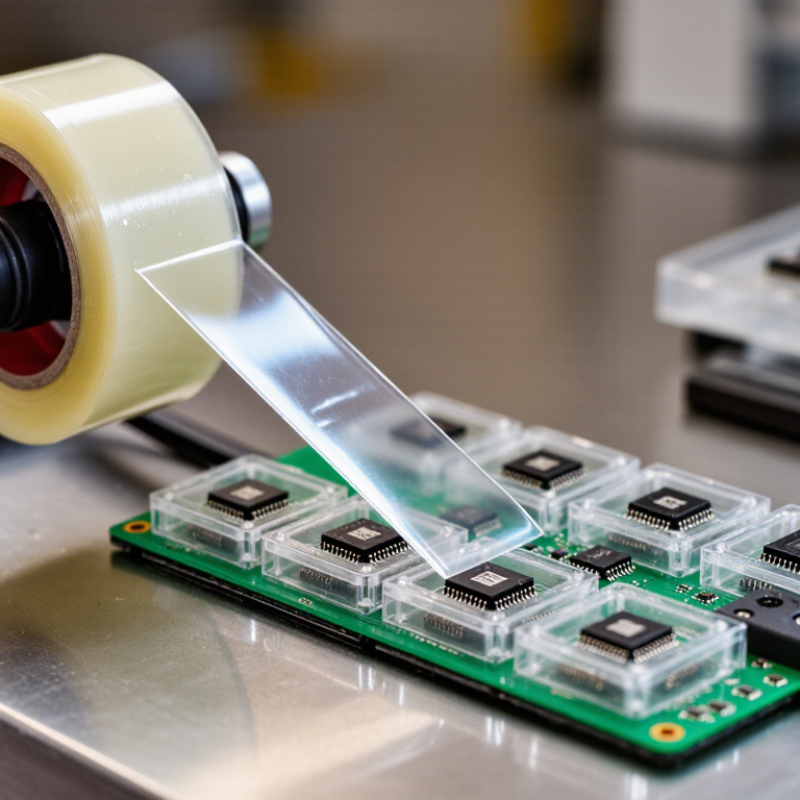
Why Is Heat Sealing Cover Tape Important?

What Is Heat Sealing Cover Tape?

Heat sealing cover tape is a protective film used with carrier tape packaging. It closes pockets containing electronic components during storage, transport, and automated assembly. The tape usually combines a polymer film with a heat-activated adhesive layer. Controlled heat bonds it to the carrier tape without damaging the components inside.

The seal must hold firmly, yet peel smoothly at the placement machine. Too little heat can create open edges or weak seals. Too much heat may distort the carrier tape. EIA-481 guidance supports consistent carrier tape dimensions and packaging performance. It also highlights why accurate sealing conditions matter. A wider seal is not automatically safer. Material compatibility, temperature, pressure, and dwell time must work together.

Demand for reliable packaging is rising with electronics production. The World Semiconductor Trade Statistics Spring 2024 forecast estimated global semiconductor sales would reach 611.2 billion US dollars in 2024. More components require stable handling from the factory to the assembly line. In practical testing, technicians should inspect peel force, seal continuity, static behavior, and visual damage. Small wrinkles can become serious feeding problems. The process is not foolproof. Humidity, dust, and uneven tooling can still reduce reliability. Periodic checks remain necessary, even when the same tape appears to perform consistently.

How Does Heat Sealing Cover Tape Work?

Heat sealing cover tape protects components inside carrier tape pockets during feeding, transport, and storage. Its importance becomes clearer as production volumes rise. The SEMI World Fab Forecast 2024 projects global semiconductor capacity at about 33.7 million 300 mm-equivalent wafers per month in 2025. Small sealing failures can therefore affect millions of parts.

The process is precise, not complicated. A sealing head warms the tape’s adhesive layer. Pressure then pushes the softened adhesive against the carrier tape. Heat, pressure, and dwell time create the bond. After cooling, the adhesive stabilizes and holds the tape closed. During placement, the cover tape peels away at a controlled angle and speed. ANSI/EIA-481-D uses defined peel testing, commonly referencing forces around 0.1 to 1.3 N. The target must protect parts without slowing automated peeling.

Material choice matters. A cover tape may need antistatic behavior, clean peeling, optical clarity, or resistance to humidity. IPC/JEDEC J-STD-033 also emphasizes moisture control for moisture-sensitive devices, although sealing tape alone cannot replace proper dry-pack handling. That point is often missed. Excessive heat can distort pockets or stress components. Weak sealing can expose them to dust and moisture. A wider seal is not automatically safer. In practical trials, operators should record temperature, pressure, dwell time, peel force, and visual defects. The process may look stable, yet minor batch variation can still cause feeding interruptions.

Why Is Heat Sealing Cover Tape Important? - How Does Heat Sealing Cover Tape Work?

Data Dimension Typical Data or Condition How It Works Why It Matters
Primary purpose Seals the pocket of a carrier tape while allowing controlled opening during component feeding. Heat activates the sealant layer on the cover tape and bonds it to the carrier tape flange. Protects components from falling out, dust, moisture, and handling damage.
Typical tape construction Transparent or translucent multilayer film, commonly including a polyester support layer and a heat-sealable polymer layer. The support layer provides dimensional stability, while the sealant layer softens under heat and forms the bond. The layered structure balances strength, visibility, sealing performance, and peelability.
Common carrier-tape compatibility Paper, polystyrene, polyester, and polycarbonate carrier tapes, depending on the cover-tape sealant system. The sealant is selected to wet and bond with the carrier-tape flange without damaging the pocket or components. Correct material matching reduces weak seals, excessive adhesion, and tape delamination.
Typical sealing temperature Approximately 120–180 °C as an initial process range; the exact value depends on the sealant and carrier tape. A heated sealing shoe or roller transfers controlled heat through the cover tape to the sealing interface. Insufficient heat can cause seal failure, while excessive heat may deform the carrier tape or damage heat-sensitive parts.
Typical dwell time Often about 0.5–2.0 seconds during laboratory or line setup; production settings vary by equipment speed and materials. The tape remains under heat and pressure long enough for the sealant to soften, flow, and bond. Dwell time affects bond formation, line speed, and the consistency of the peel force.
Sealing pressure A controlled, uniform line pressure is required; the correct setting depends on tape width, equipment, and substrate. Pressure brings the softened sealant into continuous contact with the carrier-tape flange. Uneven pressure can create channels, weak areas, wrinkles, or inconsistent opening behavior.
Peel strength A commonly targeted range is approximately 0.5–1.5 N per 15 mm, subject to the applicable specification and application. The sealant is engineered to hold during transport but separate at a controlled force when the feeder opens the tape. Too little peel strength risks accidental opening; too much can interrupt feeding or dislodge small components.
Opening direction Peel behavior may be designed for a specified angle, commonly evaluated at approximately 165°–180° in testing. The cover tape peels away from the carrier flange rather than tearing through the pocket. Predictable peeling supports stable component presentation and reduces tape fragments.
Component visibility Transparent films allow visual inspection of pocket occupancy, orientation, and component condition. Light passes through the clear support and sealant layers before the tape is removed. Visibility helps detect missing, shifted, or incorrectly oriented components before assembly.
Moisture and dust protection A continuous seal helps limit exposure to airborne particles and ambient humidity during storage and transport. The bonded interface closes the pocket opening along the carrier-tape flange. Cleaner pockets improve feeding reliability and help protect sensitive components before placement.
Process-control checks Check temperature, pressure, dwell time, alignment, peel force, wrinkles, and seal continuity. Each variable influences the heat-transfer and bonding cycle at the seal interface. Routine checks reduce production stoppages, component loss, and inconsistent feeder performance.
Main failure modes Weak seal, excessive peel force, wrinkling, channel leaks, edge lifting, delamination, or carrier deformation. Failures usually result from incorrect temperature, pressure, speed, alignment, contamination, or material pairing. Identifying the failure mode helps determine whether to adjust the process or select a different tape construction.

Note: The numerical ranges are typical starting points for process development. Actual settings and acceptance limits should be established through material-specific trials and the relevant packaging or carrier-tape specification.

What Functions Does Heat Sealing Cover Tape Provide?

Heat sealing cover tape secures electronic components inside carrier tape pockets during storage and transport. Its primary function is retention. It prevents resistors, sensors, and small connectors from lifting, sliding, or spilling before placement. The sealed pocket also limits exposure to dust, moisture, and handling contact. This protection matters when components travel through vibration, temperature changes, or repeated loading.

The tape must provide a controlled peel force. If the seal is too weak, components can escape. If it is too strong, the placement machine may struggle to open the pocket cleanly. Heat, pressure, and dwell time affect this balance. So does the pocket material. Experienced operators normally check peel behavior, seal width, and pocket damage during process validation. Small changes can matter.

Static control is another useful function, especially for sensitive components. A suitable cover tape can reduce electrostatic risks when properly matched with the packaging system. It also supports visual inspection, since clear or stable tape allows operators to confirm pocket position and component presence. Stronger is not always better. That assumption can create problems. Real production conditions deserve testing, not guesswork. Sample rolls should be evaluated after aging, handling, and temperature exposure. Even then, results may vary between machines, so process records should remain detailed and current.

Which Materials Are Used in Heat Sealing Cover Tape?

Heat sealing cover tape usually combines a clear carrier film with a heat-activated sealing layer.

Polyester, often called PET, is widely used for the carrier because it offers strength, transparency, and stable dimensions. It helps operators inspect electronic components through the tape during automated assembly. Polypropylene can also serve as a carrier when flexibility and lower material cost matter.

The sealing layer determines how the tape bonds to the carrier tape.

Common choices include EVA, polyethylene, modified acrylic compounds, and ionomer-based materials. Each option behaves differently under heat. EVA can provide a reliable seal at moderate temperatures, while acrylic formulations may offer cleaner release and stronger chemical resistance. Ionomer layers can balance toughness and sealing performance, but they may cost more.

Material compatibility needs practical testing.

The sealing coating must bond firmly without tearing the carrier tape or leaving residue on small components. Temperature, dwell time, pressure, and storage conditions all affect the result. A tape that performs well on one carrier may fail on another. That part is often underestimated.

In production, technicians usually check peel strength, seal appearance, and component movement after sealing.

They may also inspect the tape after aging or humidity exposure. No material is perfect. A stronger seal can sometimes make peeling too aggressive. A softer layer may release smoothly but reduce package security. Careful trials remain essential.

How Should Heat Sealing Cover Tape Be Selected and Applied?

Heat sealing cover tape protects components from dust, moisture, and accidental loss during transport. It also helps automated machines pick parts reliably. However, performance depends on correct selection and application, not appearance alone.

Choose tape according to the carrier material, component weight, and sealing equipment. Check the recommended sealing temperature, pressure, dwell time, and peel strength. Antistatic performance may also matter for sensitive electronic parts. A tape that seals well on paper can still damage pockets or leave adhesive residue. I have seen this happen during rushed production trials. Test the actual carrier tape, not only a small sample.

Before sealing, keep the tape and reels clean and dry. Align the tape evenly across the pocket openings. Excessive tension can distort the carrier tape, while weak tension may create wrinkles and open seals. Begin with a controlled trial using a short reel section. Inspect the seal continuously, then perform a peel test at the intended machine speed. Record temperature, pressure, dwell time, lot information, and storage conditions. Small changes in humidity can affect results. Do not assume one setting fits every reel. That assumption is risky. Recheck the process after changing components, carrier materials, or sealing equipment. A clear inspection record makes failures easier to trace and correct.

Why Is Heat Sealing Cover Tape Important?

Heat sealing cover tape protects components from contamination while maintaining controlled peelability during automated packaging. The sealing temperature must match the tray material and sealing layer to achieve a reliable seal without deformation or excessive peel force.

The temperature windows shown are representative process-development starting ranges for common tray materials. Actual settings depend on the cover tape’s sealant, sealing pressure, dwell time, equipment, and component sensitivity. Validate the final process through seal integrity, peel-force, and visual inspection testing.

×
img

    Contact Info

    Phone number

    661-392-8948

    Address info

    3451 Pegasus Drive, Bakersfield, CA USA