
Blog
- Home
- Blog
China Top 10 Oil Immersed Transformer Manufacturers
Choosing an oil-immersed transformer involves more than comparing rated capacity or purchase price. Buyers also need to assess insulation design, cooling performance, manufacturing consistency, and the support available after delivery. China’s transformer industry includes manufacturers serving utility, industrial, and renewable-energy projects, but their products and capabilities are not identical. An Electric Transformer Oil-Immersed Transformer must match its actual operating conditions, from voltage level and load profile to ambient temperature and installation environment. Small details matter. Clear specifications can prevent costly mismatches later.
This guide introduces ten manufacturers in China and offers a practical starting point for comparing them. It focuses on product ranges, engineering capabilities, quality controls, project experience, and service arrangements, rather than treating a ranking as a guarantee of suitability. Buyers should verify current product data, test documentation, applicable certifications, and references directly with each supplier. Ask specific questions about routine and type testing, delivery schedules, spare parts, and technical assistance. A datasheet helps, but it cannot answer every site-specific question. No list can replace an engineering review, and that limitation deserves attention. Use the profiles to narrow your options, then compare quotations against the same technical requirements. Careful verification makes the selection process more reliable.
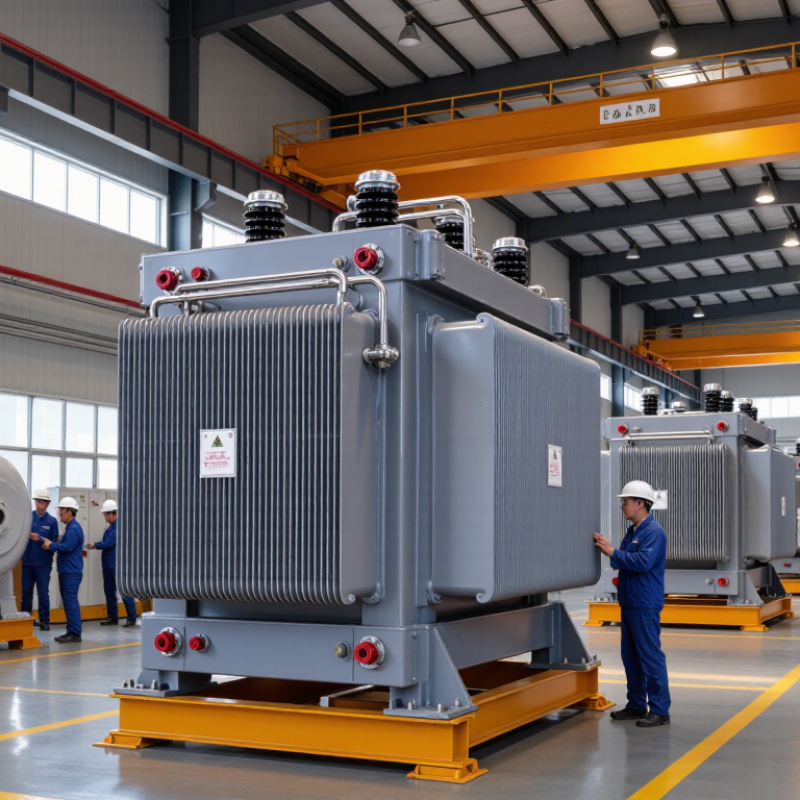
Oil-Immersed Transformers: Core Design, Insulation, and Cooling Principles
An oil-immersed transformer uses a laminated steel core to guide magnetic flux and copper or aluminum windings to transfer electrical energy. Core joints and clamping pressure affect losses, noise, and vibration. Small details matter. A poorly fitted joint can create extra heat, even when the exterior looks sound.
Insulation depends on both liquid oil and solid materials, usually paper wrapped around conductors. The oil separates energized parts, carries heat, and helps limit electrical discharge. Moisture is a concern: damp paper loses insulating strength and ages faster. Routine oil sampling can check moisture, acidity, and dissolved gases, while visual inspection may reveal leaks or damaged seals. A clear sample alone is not proof of a healthy unit.
Cooling moves heat from the windings into the oil, then through tank walls or radiators into surrounding air. Smaller units may rely on natural oil and air circulation; larger designs can use fans or pumps when loads rise. Temperature readings are useful, but they reflect operating conditions and sensor placement. No design is maintenance-free. In practice, dusty radiators, loose connections, or changing load patterns can undermine assumptions made during design.
| No. | Design Area | Typical Configuration or Value | Engineering Purpose |
|---|---|---|---|
| 1 | Core construction | Stacked, grain-oriented electrical steel laminations with insulated surfaces | Reduces eddy-current losses and helps limit no-load losses and core heating. |
| 2 | Core joints | Step-lap joints are commonly used in distribution and power transformer cores | Improves magnetic flux continuity at joints and can reduce excitation current and noise. |
| 3 | Winding conductors | Copper or aluminum conductors, selected according to rating, cost, and design requirements | Carry load current; conductor size and winding arrangement affect resistance losses and temperature rise. |
| 4 | Solid insulation | Cellulose-based electrical paper and pressboard are widely used with liquid insulation | Separates energized parts and provides mechanical support; moisture and heat accelerate cellulose aging. |
| 5 | Liquid insulation | Mineral insulating oil is common; natural or synthetic ester liquids are also used in some designs | Provides dielectric insulation and transfers heat from windings and the core to the cooling surfaces. |
| 6 | Oil preservation | Sealed-tank or conservator arrangements, depending on transformer design and application | Manages oil-volume changes with temperature and helps limit contact between oil and ambient air. |
| 7 | ONAN cooling | Oil Natural, Air Natural: oil circulates by natural convection and heat dissipates to surrounding air | A common passive cooling method for transformers whose rating and installation conditions permit it. |
| 8 | Forced cooling options | ONAF uses forced air; OFAF uses forced oil and forced air; ODAF uses directed oil flow and forced air | Fans and/or pumps increase heat removal when a design requires greater cooling capacity. |
| 9 | Temperature-rise limits | IEC 60076-2 gives, for applicable conventional liquid-immersed designs, limits including 60 K top-liquid rise and 65 K average-winding rise | Specified limits depend on transformer design and standard requirements; actual permissible values must be checked against the applicable specification. |
| 10 | Testing and loading guidance | IEC 60076 covers power-transformer requirements and tests; IEC 60076-7 provides guidance for mineral-oil-immersed transformer loading | Testing verifies defined performance characteristics, while loading guidance considers temperature and insulation aging. |

Key Specifications: Rated Capacity, Voltage, Impedance, and Losses
When comparing China’s oil-immersed transformer manufacturers, start with the rated capacity and the duty expected at the installation site. A unit serving a small commercial building has different demands from one feeding an industrial workshop. Check the stated kVA rating, cooling method, and temperature-rise limits together. Capacity alone does not show how the transformer will perform during sustained loading. Details matter.
Voltage ratings should match the system’s primary and secondary requirements, including the specified tap range. Confirm the frequency and insulation levels in the technical documents, not only in a sales table. Impedance affects fault current and voltage regulation, so compare the guaranteed value with the project specification. A small mismatch may complicate coordination with upstream protection. Easy to miss.
Losses deserve close attention because they continue throughout the equipment’s service life. Review no-load and load-loss figures separately, and check the test conditions behind them. Ask for routine test reports and verify that quoted values correspond to the exact capacity and voltage configuration. Drawings, nameplates, and test records should agree. They sometimes don’t. That deserves a second look. A tidy datasheet is useful, but it cannot replace clear answers about tolerances, cooling, and actual operating conditions. For a shortlist of suppliers, compare the same specifications on the same basis, then record any assumptions that still need confirmation.
Oil-Immersed Transformers: Key Specification Overview
Common rated-capacity classes used for oil-immersed power and distribution transformers. This anonymous overview is not a manufacturer ranking or a comparison of specific products.
Rated capacity is shown in kVA. Primary and secondary voltage, impedance, and load and no-load losses vary by design and must be confirmed from the individual transformer nameplate or product datasheet.
Thermal Benchmarks: IEC 60076 Limits of 60 K Oil and 65 K Winding Rise
For oil-immersed transformers, temperature rise is a practical benchmark, not just a catalogue figure. IEC 60076-2:2011 sets a typical limit of 60 K for top-liquid rise and 65 K for average winding rise under its specified test conditions. These values describe temperature above ambient, not absolute operating temperatures. At a 30°C ambient, for example, a 60 K rise corresponds to 90°C top oil. The winding figure is an average, not the hottest spot. Details matter.
In factory testing, engineers measure oil temperatures and winding resistance, then compare results with the applicable IEC limits. A small margin can be useful, but it does not replace sound cooling design or careful loading. CIGRE’s transformer loading guidance also emphasizes that insulation ageing depends on temperature over time, especially at the winding hot spot. So two units with similar rise-test results may age differently under different duty cycles.
Real sites vary. Cooling radiators can collect dust; fans may not run as expected. That is easy to overlook. When comparing manufacturers, check the test method, ambient correction, cooling mode, and stated tolerances—not only the headline 60 K and 65 K figures. The standard provides a reference, not a guarantee of identical field performance.
China’s Top 10 Manufacturers: Product Range, Certifications, and Test Capacity
For buyers comparing China’s top ten oil-immersed transformer manufacturers, product range is a practical starting point. Check rated capacity, voltage class, cooling method, and options such as conservators and detachable radiators. A factory may offer distribution and power transformers, but that does not prove every model suits your site. Ask for drawings and a model-specific technical schedule.
Certification and test capacity need equal scrutiny. Request current quality-system certificates, applicable IEC 60076 compliance documents, and sample routine-test reports. Confirm whether the factory can perform temperature-rise, impulse, and sound-level tests in-house, and ask for the test-bay capacity and calibrated instrument records.
The IEA’s Electricity 2024 report projects global electricity demand growth averaging about 3.4% annually from 2024 to 2026. That context makes reliable equipment evaluation more important, but demand growth alone is not proof of supplier quality. Paperwork can look tidy. Test evidence matters more.
Tips:
Match test capacity to the unit you plan to order. Verify reports against the exact model, not a similar product. If a certificate’s scope is unclear, ask for clarification in writing.
Supplier Evaluation: GB 20052-2020 Efficiency Grades and After-Sales Support
China Top 10 Oil Immersed Transformer Manufacturers
Supplier Evaluation: GB 20052-2020 Efficiency Grades and After-Sales Support
A supplier’s efficiency claim needs more than a grade printed on a brochure. Ask for the GB 20052-2020 grade and a test report for the exact transformer model being quoted. Check rated capacity, voltage, and cooling arrangement; comparisons can mislead when these differ. Numbers matter. Confirm the reported no-load and load losses against the model’s nameplate data, and ask whether testing was conducted by a qualified laboratory. Grade 1 represents the highest efficiency level under the standard, but a higher grade should still be supported by traceable documents.
After-sales support deserves the same scrutiny as technical specifications. Request written warranty terms, response times, commissioning scope, and the location of service personnel. Who handles oil sampling or fault diagnosis? Ask about spare-part availability and whether service costs include travel. Get clear answers. A low purchase price can become less attractive if routine support takes weeks to arrange.
Keep the evaluation practical: request sample service records, inspection checklists, and a named technical contact before signing. Then compare the promised support with the distance to your site and the transformer’s operating environment. Paper commitments are useful, but details can still be vague. Flag those gaps and seek clarification in writing.
(780) 669-9420