 (780) 669-9420

China Top 10 4 Gate Valve Manufacturers?
China’s gate valve industry supports pipelines that rarely attract public attention. These valves control water, oil, gas, steam, and corrosive process media. A reliable 4 gate valve must operate smoothly, seal consistently, and withstand repeated pressure cycles.
Industry reports show why supplier selection matters. Grand View Research valued the global industrial valves market at approximately USD 77.6 billion in 2023. It also expects continued growth through 2030, driven by water treatment, energy, chemicals, and infrastructure investment. Fortune Business Insights similarly identifies industrial expansion and replacement demand as important market drivers. These figures describe broad valve demand, not gate valves alone. That distinction matters.
China remains a major manufacturing base for industrial valve products. Its advantages include extensive foundry capacity, machining experience, export infrastructure, and competitive production costs. However, low pricing does not automatically prove engineering quality. Buyers should examine pressure ratings, body materials, end connections, coating systems, packing design, and documented testing procedures.
This guide reviews ten Chinese manufacturers associated with gate valve production. The assessment considers manufacturing experience, certifications, product range, project references, export capability, and after-sales support. Available information is not equally transparent across every company. Some rankings may therefore require further verification.
Look beyond catalogs.
A practical review should include hydrostatic test records, API or ISO compliance, traceability documents, and delivery performance. Field experience also matters. A valve that performs well in a clean-water line may fail in abrasive slurry or high-temperature service. The best supplier depends on the application, not reputation alone. This comparison aims to provide a useful starting point while acknowledging that procurement decisions still require technical audits and site-specific evaluation.
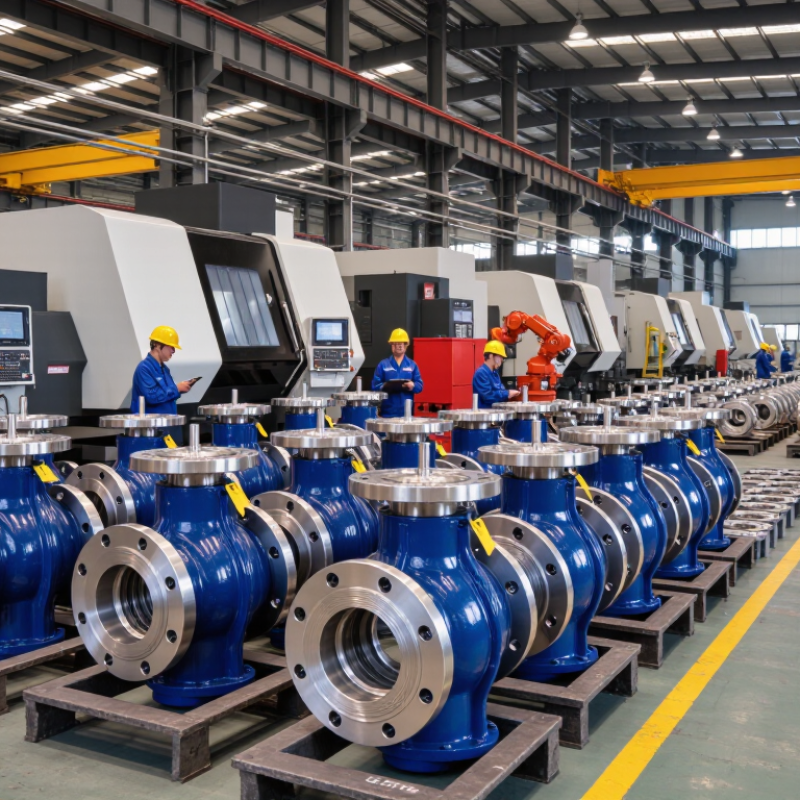
What Defines a Leading Gate Valve Manufacturer in China?
What Defines a Leading Gate Valve Manufacturer in China?
A leading gate valve manufacturer offers more than competitive pricing. It combines proven engineering, controlled production, and dependable after-sales support. MarketsandMarkets reports that the global industrial valves market may grow from about USD 78 billion in 2024 to nearly USD 98 billion by 2029. This growth increases pressure on Chinese suppliers to prove quality, not merely promise it.
Experienced buyers should inspect material traceability, machining accuracy, and pressure-test records. Each valve should have identifiable heat numbers, inspection reports, and clear leakage results. Compliance with standards such as API 600, API 6D, ISO 5208, and ASME requirements can strengthen technical credibility. However, certificates alone are not enough. A polished brochure proves little. Factory audits should examine casting surfaces, welding areas, calibration controls, and final assembly. Real expertise appears in small details, such as smooth stem operation and consistent seat contact.
Tips: Request a sample inspection plan before ordering. Check whether testing covers the actual pressure class, temperature, and medium. Ask for references from similar pipeline or process applications. Delivery performance also matters, but it should never replace technical evaluation. No manufacturer is perfect, and even strong suppliers may show gaps in documentation or communication. Those weaknesses deserve discussion before production, not after installation.
China Top 10 4 Gate Valve Manufacturers? - What Defines a Leading Gate Valve Manufacturer in China?
A standards-based comparison framework for evaluating leading Chinese gate valve manufacturers without displaying company or brand names
| No. | Evaluation Dimension | Verified Capability or Practical Benchmark | Relevant Standard or Documentation | Why It Defines a Leading Manufacturer |
|---|---|---|---|---|
| 1 | Product Range and Pressure Coverage | Ability to supply wedge, slab, expanding, parallel-slide, and compact gate valves across common nominal sizes and pressure classes, including ASME Class 150, 300, 600, 900, 1500, and 2500 where applicable. | ASME B16.34 API 600 API 602 API 6D | A broad, properly documented range allows one qualified supplier to support water, power, chemical, oil, gas, and pipeline applications. |
| 2 | Design and Engineering Capability | Engineering control over body design, bonnet construction, stem arrangement, backseat design, wedge or slab geometry, pressure-temperature ratings, and face-to-face dimensions. | ASME B16.34 ASME B16.10 API 600 API 6D | Sound engineering reduces operating torque, leakage risk, dimensional conflicts, and failures caused by unsuitable service conditions. |
| 3 | Material Selection and Metallurgy | Documented material options may include carbon steel such as ASTM A216 WCB, stainless steel such as ASTM A351 CF8M, and other alloys selected according to temperature, corrosion, pressure, and fluid chemistry. | ASTM A216 ASTM A351 ASTM A995 EN 10204 | Correct metallurgy is essential for pressure integrity, corrosion resistance, low-temperature service, and long-term reliability. |
| 4 | Manufacturing and Process Control | Controlled casting or forging, heat treatment, machining, welding, surface finishing, assembly, cleaning, and preservation processes with measurable inspection points. | ISO 9001 ASME B16.34 API 600 | Consistent process control improves interchangeability, dimensional accuracy, sealing performance, and production repeatability. |
| 5 | Pressure and Seat Testing | Each valve should be tested for shell integrity and seat tightness using documented test pressure, duration, medium, acceptance criteria, and calibrated instruments. | API 598 ISO 5208 EN 12266-1 | Independent test records provide direct evidence that the valve can withstand pressure and meet the specified leakage class. |
| 6 | Fire-Safe and Fugitive-Emission Performance | For hydrocarbon service, the manufacturer should offer designs qualified for fire-safe performance and, when specified, low-emission packing and stem-sealing solutions. | API 6FA ISO 10497 ISO 15848-1 | These capabilities reduce fire escalation risk and help control the release of hazardous or environmentally sensitive fluids. |
| 7 | Pipeline and Severe-Service Expertise | Capability to supply full-bore or reduced-bore pipeline gate valves, including suitable sealing systems, drain and vent arrangements, actuator interfaces, and pigging-compatible designs where required. | API 6D ISO 14313 ASME B16.34 | Pipeline applications require reliable isolation, controlled leakage, operational durability, and compatibility with pipeline maintenance procedures. |
| 8 | Sour-Service and Corrosion Control | For hydrogen sulfide or corrosive environments, the supplier should provide material qualification, hardness control, corrosion allowance, coating details, and compatibility documentation. | NACE MR0175 ISO 15156 NACE MR0103 | Correct sour-service selection helps prevent sulfide stress cracking, hydrogen-related damage, and premature loss of pressure containment. |
| 9 | Quality Documentation and Traceability | A complete manufacturing record should identify heat numbers, material certificates, inspection results, non-destructive examination reports, pressure-test records, calibration status, and final release documents. | EN 10204 Type 3.1 ISO 9001 API 598 | Traceability enables purchasers and end users to verify materials, inspection history, compliance, and accountability throughout the supply chain. |
| 10 | Customization, Certification, and After-Sales Support | Ability to provide customized ends, coatings, trims, actuators, locking devices, limit switches, special packing, export documentation, spare parts, and technical support according to project specifications. | ASME B16.5 ASME B16.47 IEC 60534-4 ISO 9001 | Application-specific engineering and lifecycle support reduce installation problems, commissioning delays, maintenance costs, and total ownership risk. |
Note: The benchmarks above are technical evaluation criteria rather than claims about any named manufacturer. Final supplier selection should be based on current certificates, product drawings, inspection and test plans, material records, reference projects, and project-specific compliance requirements.
Related Posts
-
Why Choose a 4 Gate Valve for Your Industrial Applications?
-
2026 Top Types of 4 Gate Valve to Consider for Your Projects?
-
2026 How to Choose the Right 4 Gate Valve for Your Needs?
-
How to Choose the Right 4 Gate Valve for Your Project?
-
Why Choose a Gate Valve: Benefits and Applications in Modern Plumbing Systems
-
2026 Top Gate Valve Types for Your Industrial Applications?