What Is a LiFePO4 Battery and How Does It Work?
A Lifepo4 Battery stores energy through a chemical reaction inside its cells. Its cathode uses lithium iron phosphate, while its anode commonly uses graphite. During discharge, lithium ions move through the electrolyte toward the anode, while electrons travel through the external circuit and power a device. That current can run a camper’s lights or support a home energy system. The process reverses during charging. Simple in outline, but the details matter.
Compared with many conventional lead-acid batteries, LiFePO4 batteries are known for stable operation, long cycle life, and useful power delivery. They are not magic, though. Temperature, charging settings, cell quality, and the battery management system all affect performance. A useful paraphrase of battery researcher Dr. Jeff Dahn’s work is that cell life depends on more than chemistry alone; design and operating conditions matter too. That is worth remembering when comparing products.
Inside a battery pack, the management system monitors cell voltage and temperature, and helps prevent unsafe operating conditions. Look for clear specifications, including usable capacity, recommended charging limits, and cycle-life test conditions. A capacity figure on a label does not tell the whole story. Nor does a long warranty prove that every pack will perform identically. Even good data has limits. This guide explains the chemistry, the movement of ions and electrons, and the practical factors that shape real-world performance—so you can judge a LiFePO4 Battery with informed expectations.
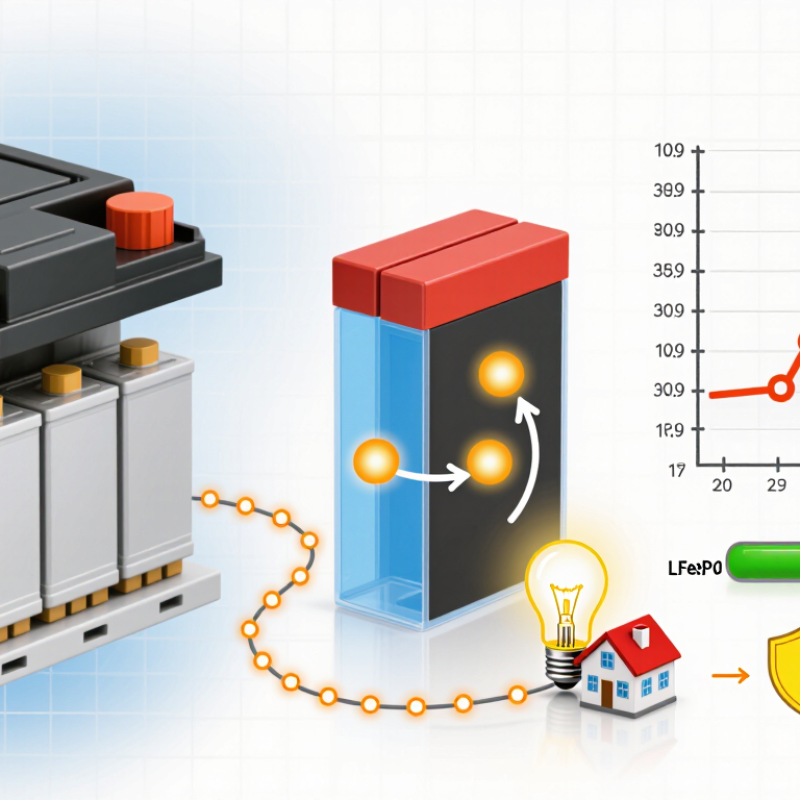
What a LiFePO4 Battery Is
A LiFePO4 battery is a type of lithium-ion battery whose cathode uses lithium iron phosphate. Its usual anode is graphite, with an electrolyte carrying lithium ions between the electrodes. A typical cell has a nominal voltage of about 3.2 volts. During discharge, lithium ions move toward the cathode while electrons flow through the connected device, powering a lamp or motor. The separator keeps the electrodes apart. That matters.
LiFePO4 is often valued for stable performance and a lower reliance on nickel and cobalt than some other lithium-ion chemistries. The International Energy Agency’s Global EV Outlook 2024 reports that LFP reached nearly 40% of the global electric-car battery market in 2023, up from less than 10% in 2020. BloombergNEF’s 2023 battery price survey put average LFP pack prices at about $130 per kilowatt-hour, compared with $152 for nickel-based packs. These figures help explain its growing use, but they do not predict every battery’s cost or lifespan. Cell design, temperature, charging habits, and pack controls all matter. LFP cells generally offer less energy per kilogram than many nickel-rich cells, so a pack may be heavier for the same stored energy. No chemistry removes the need for careful engineering.
The Materials and Components Inside a LiFePO4 Cell
A LiFePO4 cell is a layered set of materials, not a single active powder. Its cathode contains lithium iron phosphate, whose crystal structure helps lithium ions move in and out during charging and discharging. The anode is usually graphite. Between them sits a thin, porous polymer separator. It keeps the electrodes apart while allowing ions to pass through.
The electrolyte, commonly a lithium salt dissolved in organic solvents, carries those ions through the cell. Aluminum foil supports the cathode; copper foil supports the anode. A metal or polymer casing holds the stack and limits exposure to moisture. Small details matter: a damaged separator can allow internal contact, while poor electrode coating can leave uneven paths for current. One detail is easy to overlook.
These materials help explain the chemistry’s growing use. The International Energy Agency’s Global EV Outlook 2024 reports that lithium iron phosphate batteries supplied nearly 40% of the global electric-car battery market in 2023, up from less than 10% in 2020. That figure describes market share, not a guarantee of performance in every cell. In practice, electrode thickness, particle size, electrolyte formulation, and manufacturing quality all affect capacity and lifespan. The material list looks simple on paper. The cell’s behavior is less tidy.
How Lithium Ions Move During Charging
What Is a LiFePO4 Battery and How Does It Work?
How Lithium Ions Move During Charging
A LiFePO4 battery stores energy through reversible chemical changes between its electrodes. During charging, lithium ions leave the lithium iron phosphate cathode and travel through the electrolyte toward the graphite anode. A thin separator lets ions pass but keeps the electrodes from touching. That detail matters. Electrons cannot cross the separator, so they flow through the charger and external wiring instead. At the anode, ions and electrons are stored together within the graphite structure. The process is often described like traffic moving between two sides, though the real chemistry is more complex.
Tips: Charge within the temperature range specified for your battery. Cold conditions can slow ion movement and may increase the risk of lithium plating. Use a compatible charger and battery management system, especially for low-temperature protection. Small details matter here.
Charging does not mean every ion moves at the same speed or follows a perfectly simple path. Cell design, temperature, and charging current all affect the process. LiFePO4 cells are known for stable operation, but they still need sensible charging limits. It is easy to picture ions flowing smoothly; in practice, the microscopic process is uneven. That simplified picture is useful, but not the whole story.
How Discharge Converts Stored Energy into Electrical Power
A LiFePO4 battery stores energy through chemical differences between its electrodes. During discharge, lithium atoms in the graphite negative electrode release electrons and become lithium ions. The ions pass through the electrolyte toward the iron-phosphate positive electrode. The electrons cannot cross the electrolyte, so they travel through an external circuit instead. That movement is electrical current.
A load uses this current to do work. In a flashlight, electrons flow through the lamp and produce light; in a motor, they help create rotation. The lithium ions enter the positive electrode, while the circuit carries electrons back to it. A small but important detail: the battery’s voltage stays fairly steady across much of its discharge, then falls more sharply near empty. Real cells are less tidy. Temperature, age, and load affect the voltage and usable capacity.
A battery management system monitors cell voltage, current, and temperature. If a cell approaches its safe lower-voltage limit, the system may disconnect the load. This protects the cell, but it can make a device stop suddenly rather than fade gradually. Cold conditions can also restrict ion movement, reducing available power. The simple flow-of-electrons picture is useful, though it leaves out complex chemical changes inside each electrode.
How Battery Management Supports Safety and Performance
A LiFePO4 battery stores energy through lithium ions moving between its electrodes. Its chemistry is generally more thermally stable than some other lithium-ion chemistries, but stable does not mean risk-free. A battery management system, or BMS, helps keep operation within the battery’s specified limits.
The BMS monitors cell voltages, pack current, and temperature. If one cell approaches an upper or lower voltage limit, the system can restrict charging or discharging. It may also disconnect the battery when readings exceed configured thresholds. Small details matter. Cell balancing can reduce voltage differences between cells, helping the pack use its capacity more evenly over time.
During charging, temperature checks are important because charging below the battery maker’s permitted range can damage cells. The BMS may pause charging, but it cannot compensate for unsuitable equipment or poor wiring. During discharge, current limits help protect cells and connections from excessive load. State-of-charge estimates can drift, too, especially when a battery is used in changing conditions; a display showing 20 percent is not a perfect measurement. No system is flawless. Regular checks of cables, terminals, and operating conditions still matter.
 (780) 669-9420