How to Choose the Right Power Oil Transformer?
Choosing the right Power Oil Transformer begins with the site, not the product brochure. Every installation has different demands. A rural substation may face unstable voltage, dust, and limited maintenance access. An industrial plant may need continuous operation, high starting currents, and strict noise control. These conditions should shape the transformer specification.
Experienced engineers normally review the expected load, future expansion, system voltage, frequency, altitude, and ambient temperature. They also examine cooling methods, insulation levels, impedance, oil protection, and enclosure requirements. A transformer rated only for today’s demand may become a costly restriction within a few years. Load records, thermal studies, and short-circuit calculations provide stronger evidence than estimates.
Look closely at the details. Check the nameplate, test certificates, winding material, conservator design, bushings, relays, and oil quality. Factory acceptance testing should follow recognized IEC or IEEE requirements where applicable. Independent inspection can reveal damaged accessories, incorrect wiring, or transport-related movement. Manufacturer references also matter, especially for installations operating in similar climates.
There is no universal choice.
A complete specification can still miss practical problems. For example, a correctly sized transformer may perform poorly when ventilation is blocked or maintenance access is ignored. Protection settings may require site verification after commissioning. Careful comparison should include purchase price, losses, servicing, spare parts, delivery, and expected service life. The best Power Oil Transformer is not simply the largest or cheapest option. It is the unit that matches proven operating conditions, verified technical data, and realistic maintenance capabilities.
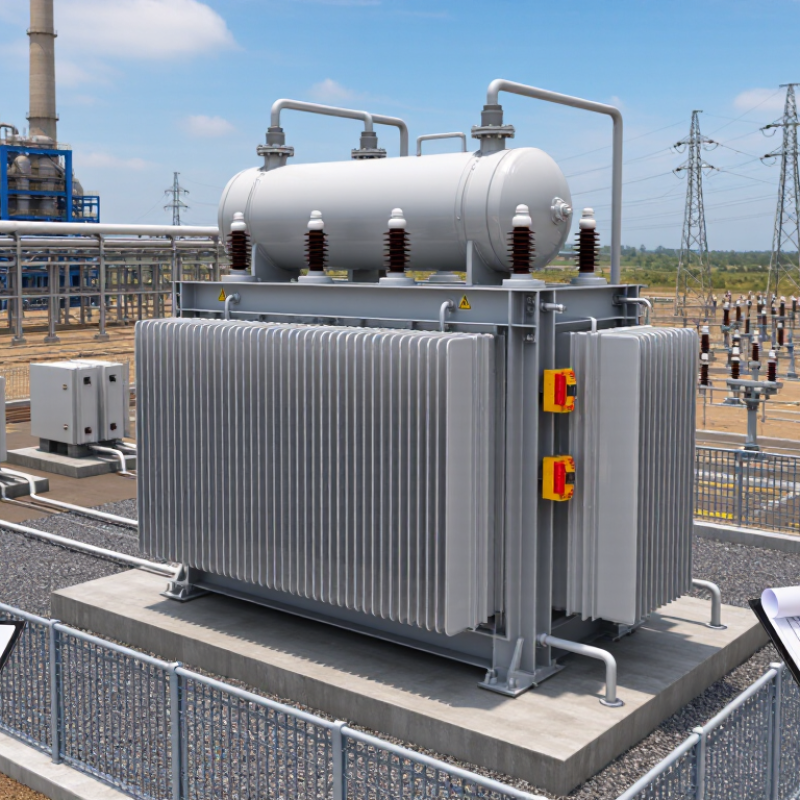
Define the Transformer’s Power, Voltage, and Application Requirements
How to Choose the Right Power Oil Transformer?
Define the transformer’s power, voltage, and application before comparing equipment. Start with measured demand, not only the connected load. Record motors, lighting, heating, harmonics, and future expansion. A 1,000 kVA unit may work today but operate poorly after a new production line arrives. Allow practical headroom, commonly 15–25%, without oversizing excessively. Oversizing increases no-load losses and purchase cost. Check the primary and secondary voltages, frequency, tap range, and grounding arrangement. IEC 60076 provides the main technical framework for power transformers.
Application conditions matter just as much. Indoor substations need different cooling, noise, and fire-risk controls than outdoor utility sites. Solar, wind, data-center, and industrial loads can create rapid changes and harmonic stress. The International Energy Agency reported that annual grid investment must exceed 600 billion dollars by 2030, more than double recent levels, in Electricity Grids and Secure Energy Transitions. That pressure makes reliable transformer selection increasingly important. The U.S. Department of Energy also identifies long transformer lead times as a grid-supply concern. Specify tested performance, accessories, protection, and maintenance access early. Ask for guaranteed losses at defined loads. Small omissions become expensive later. A neat spreadsheet is not enough. Validate assumptions with load measurements, fault studies, ambient temperature, altitude, and short-circuit requirements. My own caution is simple: forecasts are often optimistic, while transformers remain for decades.
How to Choose the Right Power Oil Transformer?
Define the transformer’s power, voltage, and application requirements before selecting an oil-immersed transformer.
The chart shows representative transformer ratings commonly used for different applications. Distribution systems often use 0.4 kV secondary voltage, while medium-voltage networks commonly operate at 11 kV or 33 kV. Higher-voltage substation transformers may use 110 kV primary voltage and power ratings of several tens of MVA. Actual selection should also consider load growth, cooling method, frequency, insulation level, short-circuit withstand, installation environment, and applicable standards.
Values are representative engineering examples, not universal limits or manufacturer-specific data.
Compare Oil Types, Cooling Methods, and Insulation Performance
Choosing the right power oil transformer requires more than checking its rated capacity. The oil type affects fire safety, maintenance, temperature control, and insulation life. Mineral oil remains widely used because it offers stable performance and broad service experience. Natural or synthetic ester fluids can provide higher fire resistance and better moisture tolerance. However, their viscosity and material compatibility require careful review. A lower fire risk does not automatically mean better overall performance.
Cooling method must match the transformer’s real operating conditions. ONAN cooling uses natural oil circulation and air movement. It is simple and often reliable for moderate loads. ONAF cooling adds fans, helping the unit manage higher temperatures. Fans can fail. Dust, blocked air paths, and poor ventilation can reduce cooling effectiveness. Check the expected load cycle, ambient temperature, and temperature-rise data before choosing a design. A factory with frequent overloads needs different cooling capacity than a lightly loaded utility site.
Insulation performance depends on oil quality, paper condition, sealing, and moisture control. Ask for test results covering breakdown voltage, water content, dissipation factor, and dissolved gas analysis. Small moisture levels can weaken paper insulation over time. Field inspections should also examine leaks, breathing equipment, bushings, and hot-spot readings. A transformer with clean oil may still have aged paper insulation. This is easy to miss. Compare verified test data with operating history, not only catalogue figures. A simple comparison can mislead.
How to Choose the Right Power Oil Transformer? - Compare Oil Types, Cooling Methods, and Insulation Performance
| Evaluation Dimension | Mineral Oil | Natural Ester Fluid | Synthetic Ester Fluid | Silicone Fluid |
| Typical flash point | Approximately 140–180°C | Typically above 300°C | Typically above 250°C | Typically around 300°C or higher |
| Fire safety | Combustible; requires greater fire-separation provisions | High fire point; suitable for areas requiring enhanced fire safety | High fire point; suitable for indoor and safety-sensitive installations | High fire point and good fire resistance; verify installation requirements |
| Biodegradability | Low to moderate; environmental persistence is comparatively higher | High biodegradability; often derived from renewable vegetable sources | Generally biodegradable; performance depends on chemical formulation | Low biodegradability compared with ester fluids |
| Moisture tolerance | Moisture significantly reduces dielectric strength and accelerates paper aging | Can retain more moisture in the fluid while maintaining comparatively stronger paper insulation | Good moisture tolerance; confirm compatibility with the transformer insulation system | Low water solubility; moisture management remains essential |
| Paper insulation aging | Good when dry, sealed, and operated within the specified temperature limits | Can substantially slow paper aging under suitable thermal and moisture conditions | Good aging performance and high thermal stability in properly designed systems | Good thermal stability; paper-aging performance depends on the complete insulation design |
| Low-temperature behavior | Usually reliable; pour point and viscosity must match the local climate | May have higher viscosity at low temperature; select a fluid rated for the site climate | Often better low-temperature flexibility than natural ester fluids | Generally good low-temperature performance; verify viscosity at startup temperature |
| Typical dielectric strength of conditioned fluid | Often designed to meet approximately 50–70 kV per 2.5 mm, depending on test standard and condition | Can achieve comparable insulation performance when properly processed and maintained | Can achieve high dielectric strength with suitable purification and sealed operation | High dielectric performance when clean and dry; test values depend strongly on fluid condition |
| Relative cost and availability | Lowest initial cost and broadest service availability | Higher initial cost; availability depends on region and supply chain | Higher initial cost; useful where fire safety and long service life justify the investment | Higher fluid cost; maintenance and compatibility requirements must be reviewed |
| Recommended cooling method | ONAN for smaller ratings; ONAF or OFAF for higher loads | ONAN or ONAF; confirm viscosity, pump compatibility, and thermal design | ONAN, ONAF, or OFAF depending on rating and enclosure requirements | Usually ONAN or ONAF; forced circulation requires manufacturer and fluid approval |
| Best-fit applications | General utility, industrial, and outdoor distribution or power transformers | Ecologically sensitive sites, indoor substations, and installations with higher fire-safety requirements | Indoor substations, high-value equipment, and projects prioritizing fire safety and stable performance | Special fire-risk environments and applications requiring high thermal stability |
Cooling method guide: ONAN = Oil Natural, Air Natural; ONAF = Oil Natural, Air Forced; OFAF = Oil Forced, Air Forced; OFWF = Oil Forced, Water Forced. Actual transformer ratings, temperature rises, insulation levels, and fluid test limits must be confirmed against the applicable IEC, IEEE, or local standard and the project specification.
Select the Appropriate Capacity, Phase, and Connection Configuration
Choosing the right power oil transformer starts with the actual load, not a guess from the nameplate.
Calculate the continuous demand, starting current, and expected future growth. Record motor starts, welding cycles, and seasonal production changes. A workshop may draw moderate power all day, then demand much more for several seconds. That brief surge can matter. Do not size only from today’s average reading. Leave practical capacity for expansion, but avoid excessive oversizing. An oversized transformer may operate inefficiently at light load. I have seen projects where a generous rating increased cost without improving reliability. The first estimate is rarely perfect. Recheck it against measured data.
Phase selection must match the utility supply and connected equipment. Single-phase systems suit smaller, simpler loads. Three-phase systems distribute industrial power more evenly and reduce conductor stress. Connection configuration also affects voltage behavior, grounding, and fault performance. A delta connection can handle certain motor loads effectively. A grounded wye connection may provide a useful neutral for mixed-voltage equipment. These choices require careful coordination with protection devices and site regulations. Confirm the secondary voltage under load, not only at no-load conditions. Harmonic-producing equipment may require additional assessment. Keep clear records of calculations, test results, and installation conditions. Small details matter.
 (780) 669-9420