

Blog
- Home
- Blog
Best Skin Tone Analyzer Manufacturers in China?
Choosing the best Skin Tone Analyzer manufacturers in China requires more than comparing product photos or quoted prices. A dependable device should produce repeatable readings under controlled lighting, explain its measurement range, and document calibration procedures. Ask how the sensor handles warm indoor light, reflective surfaces, and different skin tones. Request sample reports, not just polished demonstrations. Small details matter.
Dermatologist Steven Q. Wang’s work on skin of color offers a useful principle: “A measurement is meaningful only when its method and limitations are clear.” This is an editorial paraphrase, not a verbatim quotation. It reflects a practical concern: a single reading cannot capture every undertone or replace professional judgment. A polished interface may still hide inconsistent results.
This guide compares Chinese manufacturers through measurable criteria: sensor design, repeatability, software options, technical support, and customization. Look for transparent test methods and clear explanations of how devices perform across lighting conditions. Ask whether the company can provide an evaluation unit and respond to technical questions in detail. A low price can be attractive. It is not proof of quality. Some suppliers may publish limited independent validation, so buyers should verify claims before choosing. The goal is not to crown a universal winner, but to identify manufacturers whose evidence, service, and device capabilities fit a specific workflow. Skin tone is nuanced. The comparison should be, too.
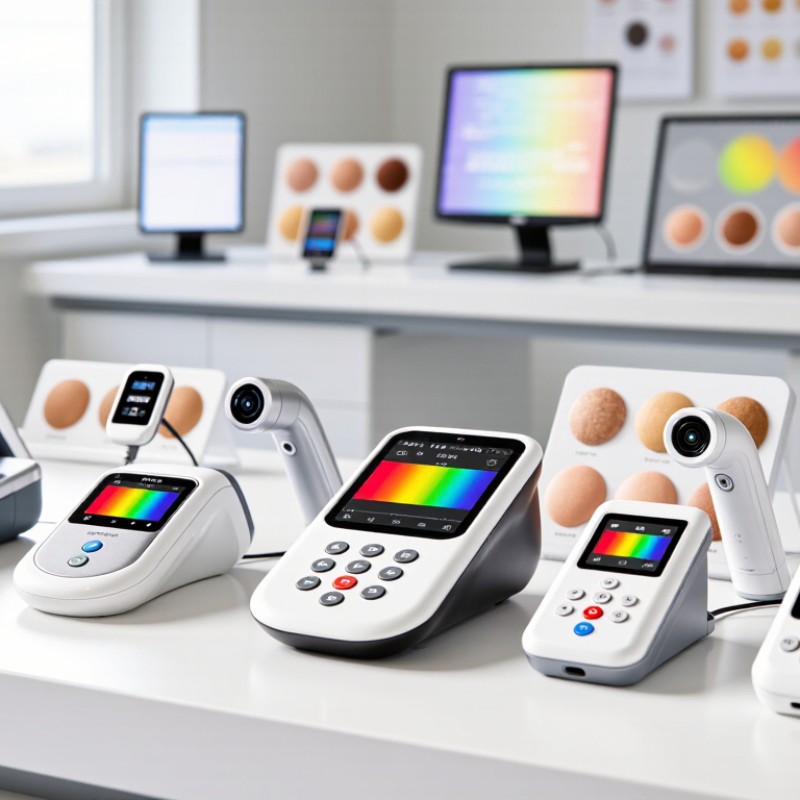
Defining Skin Tone Analyzers: Colorimeters, Spectrophotometers, and Imaging Systems
Skin tone analyzers are not one device category. A colorimeter measures reflected light through defined filters, producing practical color readings for repeat checks. It is compact and useful at a cheek or forearm. Yet its small measurement area can miss variation across the face.
A spectrophotometer records reflectance across many wavelengths, rather than reducing color to a few filter responses. This can help distinguish undertones and support repeatable product testing under controlled conditions. The 2022 technical report documenting the Monk Skin Tone scale describes ten ordered tone categories. That scale helps teams discuss representation, but it is not a device calibration standard or a substitute for measured reflectance. The distinction matters.
Imaging systems capture larger facial areas and can map tone variation across cheeks, forehead, and jaw. Their results depend heavily on illumination, camera settings, and image-processing choices. A neutral reference tile beside the subject can reveal some lighting shifts, though it cannot fix every source of error. Not interchangeable. Manufacturers should state the measurement method, calibration procedure, and repeatability data. Buyers should also ask whether readings were tested across varied skin tones. A polished dashboard is not evidence of accuracy; even careful protocols leave room for inconsistent results.

Reading Skin Color with CIE L*a*b*: L* 0–100, with a* and b* Axes
A skin tone analyzer should describe measured color, not simply label someone “warm” or “cool.” CIE L*a*b* provides three useful coordinates.
L* runs from 0, ideal black, to 100, ideal white.
The a* axis shifts from green at negative values to red at positive values.
The b* axis shifts from blue to yellow.
Together, these readings offer a clearer comparison than a single shade name.
For manufacturers in China, inspect how instruments capture and report all three values. Ask about calibration, measurement repeatability, and the recommended contact pressure or distance. A reading can change with lighting, skin moisture, recent exercise, or placement on the face. Compare the same site under consistent conditions, and check whether the device reports raw values alongside any skin-tone categories.
One limitation deserves attention: a precise number is not automatically a meaningful assessment. Results still need careful interpretation.
Tips:
Clean the measurement window and follow the device’s calibration instructions. Take several readings from the same area, then compare their spread. Small differences may reflect technique, not a real color change. Keep notes on lighting and measurement location; these details are easy to overlook.
Comparing Color Accuracy Using ISO/CIE 11664-6:2014 and the ΔE00 Formula
Comparing skin tone analyzers from manufacturers in China takes more than checking whether their screens show similar numbers. ISO/CIE 11664-6:2014 specifies the CIEDE2000 color-difference formula, commonly written as ΔE00. It helps quantify the difference between a measured skin-tone reference and an instrument reading. The standard defines a calculation method, not a universal pass-or-fail limit. That distinction matters.
Ask how each analyzer was tested. Were the same reference samples measured under controlled lighting, with consistent contact pressure and positioning? Skin is curved, textured, and affected by moisture, so results can shift between repeated readings. Small details count. A sound comparison records repeatability across light and dark tones, then checks readings against a calibrated reference instrument. It should also report the measurement conditions, rather than presenting one ΔE00 value without context. A low average can hide larger errors in particular tones. No device is perfect. Even a careful protocol may not reproduce everyday use, and that limitation deserves attention. Requesting raw results and retest data can reveal more than a polished accuracy claim.
Evaluating Chinese Manufacturers by Repeatability, Calibration, and Measurement Range
When evaluating skin tone analyzer manufacturers in China, repeatability matters more than a polished brochure. Ask for repeated readings from the same skin area, taken under consistent lighting and positioning. A reliable instrument should produce closely grouped results, not dramatic shifts between scans. Small differences can still occur because skin hydration, pressure, and room temperature affect readings. That detail is easy to overlook.
Calibration deserves equal attention. Request the calibration procedure, reference standards, and recommended service interval. Check whether the device can be verified after transport or extended use, and whether staff receive clear instructions. A calibration certificate is useful, but it does not replace a practical repeat test. Try measuring a stable reference surface several times, then repeat the test on different days. Document the conditions. Keep the raw readings.
Measurement range should match the intended application. Compare the stated range with the skin tones and measurement values your clinic or laboratory actually encounters. Ask how the analyzer performs near the lower and upper limits, where errors may become more noticeable. Also check resolution, probe contact requirements, and whether results remain comparable across units. A wide range sounds reassuring, but consistency within the relevant range is more useful. I would still want to see hands-on data before judging a supplier.
Matching Analyzer Types to Cosmetic R&D, Clinical, and Consumer Applications
For cosmetic R&D, a skin tone analyzer should support repeatable comparisons, not just attractive reports. Imaging systems can map facial color under controlled lighting, while handheld spectrophotometers measure smaller areas with focused readings. Useful details include a calibration tile, fixed positioning, and exportable color values such as CIELAB. Small setup changes matter. A shifted camera or bright window can distort results. Teams should check repeatability across skin tones and document how the device handles varied lighting and skin texture.
Clinical and consumer applications need different trade-offs. Clinical teams may favor calibrated instruments, traceable measurement procedures, and data that can be reviewed over time. These tools can support observation, but they do not replace a clinician’s assessment. Consumer devices often prioritize quick readings, simple displays, and comfortable contact with the skin. Their results should be presented as estimates, not diagnoses. When evaluating manufacturers in China, request sample-device testing, calibration records, software documentation, and clear service terms. A polished interface is not proof of accuracy. I would also ask how the manufacturer tests darker and lighter tones; this detail is easy to overlook, and no single device suits every use.
Skin Tone Analyzer Types: Matching Tools to Applications
Typical application fit by analyzer type. Scores are qualitative guidance (1 = limited fit, 5 = strong fit), not clinical performance results or market data.
RGB imaging is accessible for consumer-facing tools; colorimeters and spectrophotometers support controlled color measurement; multispectral imaging captures information across multiple wavelength bands. Clinical use requires appropriate validation and standardized measurement protocols.
(780) 669-9420