
Blog
- Home
- Blog
7 Best T Beam Welding Lines for Sale in 2026
In 2026, a T beam welding line should be judged by how well it fits the parts you actually produce. A machine’s advertised speed means little if it struggles with your flange width, web thickness, or required weld quality. A useful comparison starts with those details. It also checks the welding process, fit-up method, travel speed, power requirements, and operator controls. Small differences matter.
This guide looks at seven T beam welding lines for sale and explains what buyers should verify before making a shortlist. For each option, compare stated capacity with your drawings, then ask for machine specifications and a demonstration using similar material. Check how the line handles loading, alignment, welding, and routine adjustments. Ask about installation, training, spare parts, and service response, too. These practical details can affect production just as much as the welding head.
Specifications do not tell the whole story. A fast cycle may depend on ideal conditions, and a listed capacity may not suit every beam design. Treat sales claims as starting points, not proof. Request clear, comparable data, and confirm any important performance claim in writing. The right choice depends on your product mix, floor space, budget, and planned output. There is no universal winner. A careful review can help you identify a line that works reliably for your shop—not merely one that looks impressive on paper.
Understanding T-Beam Welding Lines and Their Industrial Uses
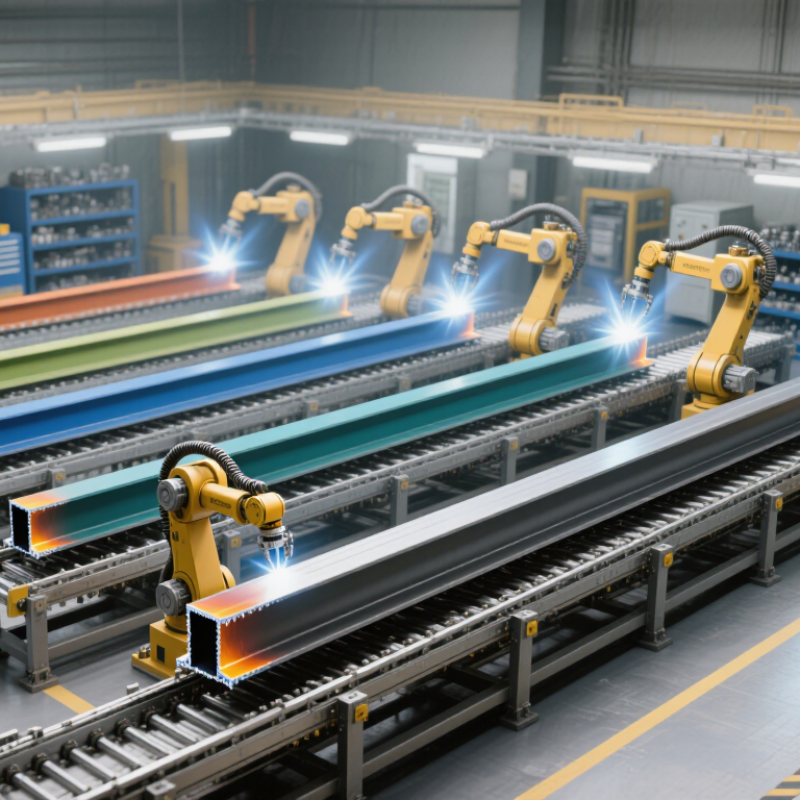
A T-beam welding line joins a vertical web to a horizontal flange, producing a structural section with a clear T-shaped profile. Typical equipment may include positioning rollers, clamping fixtures, welding heads, and a system for moving finished beams. The line keeps the web and flange aligned as they are joined. Small gaps or uneven clamping can affect weld consistency.
These beams are used in building frames, bridge components, industrial platforms, and some heavy equipment structures. Their strength and dimensions depend on the design, steel grade, and weld requirements. In production, operators monitor torch position, travel speed, and heat input. Too much heat can distort the flange; too little may leave an incomplete joint. Details matter.
When comparing T-beam welding lines for sale in 2026, match the machine to your actual beam range and production volume. Check web height, flange width, material thickness, and how quickly changeovers can be made. Ask how alignment and weld quality are verified, and review sample sections if possible. A higher output rating alone tells little. There is no perfect setup for every shop, and that is easy to overlook when comparing catalog specifications.
Key Criteria for Evaluating T-Beam Welding Lines in 2026
When comparing T-beam welding lines in 2026, start with the parts your shop actually makes. Record web height, flange width, plate thickness, and beam length from recent jobs. Ask suppliers to weld a representative section, not a specially prepared sample. Small details matter. Check whether clamps keep the web square as heat builds and whether the line handles uneven plate fit-up. Poor alignment can cause twist and rework.
Evaluate welding process, travel speed, and adjustment range against your material thickness and production volume. Request sample welds for inspection, including checks for penetration, consistency, and distortion. Confirm how operators set parameters and change between beam sizes. A fast cycle time means little if changeovers take an hour. It is easy to overlook this during a polished demonstration.
Also inspect material handling, straightening capacity, and access for maintenance. Ask how routine calibration is documented and what training is included during installation. Review realistic output figures with planned shift hours, not just peak-speed claims. There may be a trade-off between automation and flexibility. A highly automated line can reduce manual handling, yet awkward one-off sections may still need extra setup. Compare the quoted configuration with your floor space, staffing, and actual order mix before deciding.
Seven T-Beam Welding Lines for Sale in 2026
For buyers searching seven T-beam welding lines for sale in 2026, compare configurations by beam size, output, and operator involvement. A compact single-head line can suit changing job mixes. A twin-head setup may reduce cycle time on repeatable sections. Gantry-style equipment can handle longer workpieces, while submerged-arc systems are suited to continuous, heavy welds. Details matter.
Other options include manual tack-and-weld stations, robotic welding lines, and modular systems designed for later expansion. These categories can overlap: a robotic cell may use a gantry, for example. Ask sellers for verified workpiece ranges, weld-speed data, power requirements, and sample procedures. Request a demonstration using steel close to your own specifications. Brochure figures alone are not enough.
Before choosing, check how the line manages fit-up, clamping, cooling, and routine maintenance. Poor alignment can create rework, even on a highly automated line. Not glamorous, but important. Confirm what tooling and commissioning support are included in the quoted price. I would not rank seven options without knowing the required beam dimensions and production volume; that comparison can otherwise look precise while being misleading.
Comparing Capacity, Automation, and Production Flexibility
7 Best T Beam Welding Lines for Sale in 2026
Comparing Capacity, Automation, and Production Flexibility
Choosing among seven T beam welding lines means looking beyond advertised output. Compare the beam dimensions each line can handle, its welding process, and how quickly operators can adjust for another job. A line rated for high throughput may still slow down when web plates vary in thickness or flange widths change. Check how materials are loaded, aligned, tack-welded, and moved through the station. Ask suppliers for cycle-time data using profiles similar to yours, not just ideal test pieces. A sample run tells you more.
Tips: Measure your most common beam sizes and your occasional oversized profiles. Confirm changeover steps, operator requirements, and what adjustments are manual. Small delays add up.
Automation can reduce repetitive handling, but it does not eliminate setup work or quality checks. Look for clear controls, accessible weld-head adjustments, and practical safety features. Ask whether one operator can manage feeding and monitoring without rushing. Also compare service access: a sensor that is difficult to reach can turn a minor fault into lost production. Capacity figures deserve scrutiny; material preparation and fit-up affect real output. I would not choose on speed alone. Flexibility matters, though too many options can make a line harder to run consistently. Request a demonstration with your own drawings and record both output and changeover time.
Choosing the Right T-Beam Welding Line for Your Needs
A suitable T-beam welding line should match your beam dimensions, steel thickness, and expected production volume. A machine designed for narrow sections may struggle with deeper beams or frequent size changes. Check the stated capacity against the parts you actually make, not just the maximum figures in a brochure. For example, note flange width, web height, and the space needed to load each section. Ask how the line controls alignment and heat input. These details affect weld consistency and distortion. A polished specification sheet is useful, but it cannot replace a sample weld test.
Tips: Request a trial using your own material and joint dimensions. Check whether operators can adjust settings without lengthy changeovers. Confirm what routine maintenance requires, including access to rollers, clamps, and welding heads. Keep it practical.
Also compare the full workflow, not only welding speed. Look at loading, positioning, cooling, and unloading; a fast welding cycle can still leave a bottleneck elsewhere. Consider floor space, operator training, and available service support. Small defects count. Ask for clear acceptance criteria, such as dimensional tolerances and inspection methods. One trade-off deserves thought: a highly automated line may improve repeatability, yet it can be harder to adapt when product sizes vary. I would weigh flexibility against output carefully. The right choice depends on your actual mix of jobs, and that may take honest production data to establish.
| Line Configuration | Typical Welding Setup | Best Suited For | Main Advantages | Key Checks Before Purchase |
|---|---|---|---|---|
| 1. Standard Submerged Arc Welding (SAW) Line | Mechanized SAW heads weld the longitudinal web-to-flange fillets while the beam is held in alignment. | General structural fabrication and recurring T-beam production. | SAW is well suited to long, continuous welds and can provide high deposition rates with consistent operating conditions. | Confirm the specified joint geometry, welding positions, flux handling, seam tracking method, and supported steel thickness range. |
| 2. Twin-Head Simultaneous Welding Line | Two welding heads work on opposing longitudinal seams at the same time, where the machine design and weld sequence allow. | Shops seeking shorter cycle times on repeatable beam sizes. | Simultaneous welding can reduce the time spent on the two main seams and help balance heat input across the section. | Check head spacing and adjustment range, access to both seams, distortion-control procedure, and whether both sides can be welded for every specified section. |
| 3. Single-Head Adjustable Line | One mechanized welding head is repositioned or the workpiece is reoriented to complete the required seams. | Low-to-medium production volumes and workshops making varied T-beam sizes. | Typically offers a simpler layout and greater flexibility for changing beam dimensions or production schedules. | Ask how much changeover is required between sizes, how the beam is turned or indexed, and whether the operating sequence meets the required output. |
| 4. Heavy-Section T-Beam Line | Heavy-duty fixtures, supports, and welding equipment are configured for larger or heavier structural sections. | Fabricators handling thick plates, long beams, or high workpiece loads. | Designed around workpiece support, clamping, and handling needs that can exceed the capacity of a light-duty line. | Verify maximum workpiece weight and length, plate-thickness limits, fixture capacity, crane or roller-table requirements, and foundation details. |
| 5. Compact Workshop Line | A space-conscious arrangement combines beam positioning and mechanized welding within a smaller production footprint. | Smaller fabrication facilities or operations with limited floor space. | Can simplify installation and material flow where a large, fully integrated line is not practical. | Measure the complete operating envelope, including loading, unloading, maintenance access, fume extraction, and safe movement of long workpieces. |
| 6. CNC or Servo-Controlled Flexible Line | Programmed axes or servo adjustments set welding-head position and, depending on the machine, support repeatable setup changes. | Production involving multiple section sizes or frequent repeat orders. | Stored settings and controlled positioning can help make changeovers more repeatable than manual adjustment alone. | Request a live demonstration of a size change, confirm supported adjustment axes, check program storage and operator training, and clarify which settings remain manual. |
| 7. Integrated Material-Handling Line | Welding equipment is combined with infeed, positioning, conveying, and outfeed equipment; the exact level of automation varies. | Higher-throughput production with a consistent product mix and planned material flow. | Integration can reduce manual transfers between operations and coordinate welding with workpiece handling. | Review line layout, interface responsibilities, safety interlocks, handling capacity, maintenance access, and the effect of bottlenecks on total cycle time. |
(780) 669-9420