What Is the Best Pool Water Tester in 2026?
Choosing the best Pool Water Tester in 2026 is not just about buying the newest gadget. It is about getting dependable readings before cloudy water, irritated eyes, or a chemical imbalance becomes a bigger problem. A backyard pool can look clear and still need attention. Clear water can mislead.
The CDC’s 2016 report, “Pool Inspection Data from 16 Jurisdictions—United States, 2013,” reviewed 84,187 public-pool inspections. About one in eight inspections resulted in immediate closure because of serious violations. Those findings concern public pools, not home pools, but they show why consistent water checks matter. CDC guidance also identifies pH and disinfectant levels as key parts of safe pool maintenance. Small variations matter.
In this guide, we’ll compare test strips, liquid kits, and digital testers by accuracy, ease of use, cost, and the readings they provide. A tester may deliver a precise number, yet poor calibration or an expired reagent can still distort the result. That part is easy to overlook. We’ll also explain which option fits occasional checks and which suits frequent testing, using established guidance rather than flashy product claims. No single tester is perfect; the right choice depends on your pool, routine, and willingness to verify unexpected readings.
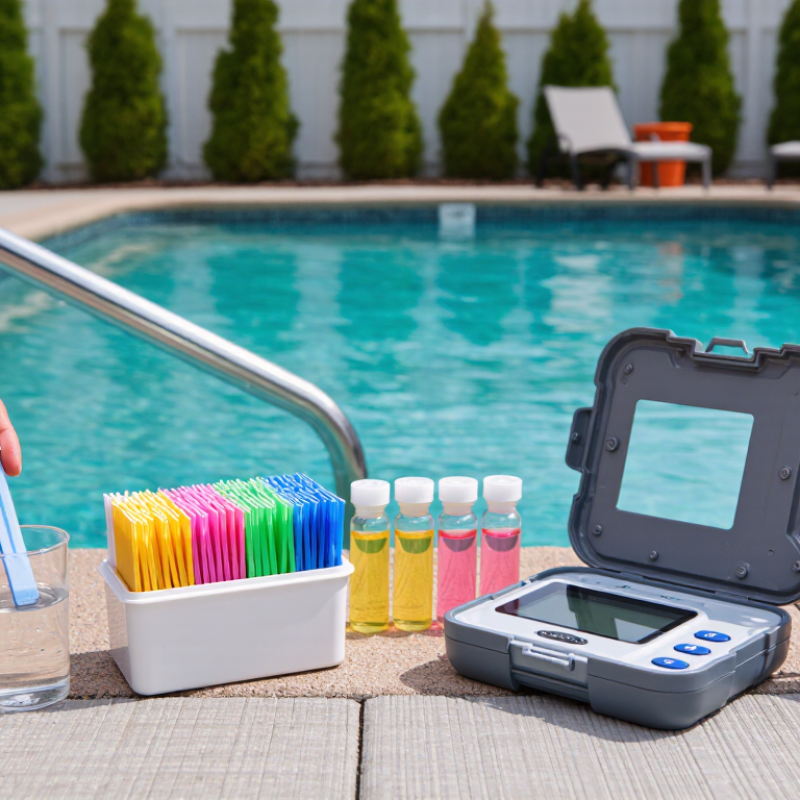
What a Pool Water Tester Measures
A pool water tester checks the chemical conditions that affect swimmer comfort and equipment. Most testers measure pH and sanitizer levels, such as free chlorine or bromine. pH shows whether water is too acidic or too alkaline. Sanitizer readings indicate how much disinfectant is available to control germs. These numbers work together. A normal chlorine reading can still be less effective when pH is out of range.
Some kits also measure total alkalinity, calcium hardness, and cyanuric acid. Alkalinity helps steady pH, while calcium hardness can indicate whether water may scale or become corrosive. Cyanuric acid helps protect chlorine from sunlight in outdoor pools. Not every tester checks every measure. Read the kit’s instructions before relying on its results.
Testing technique matters. Take a sample away from return jets, use a clean vial, and follow the stated wait time. Small details count. Strips are quick, but matching colors can feel subjective in dim light. Digital meters may give clearer numbers, yet they still need proper care and calibration. A result is only a snapshot, not a full picture of water quality. Retesting after adding chemicals, heavy rain, or many swimmers can reveal changes that one reading misses. Even careful testing can leave room for doubt.
What Is the Best Pool Water Tester in 2026? - What a Pool Water Tester Measures
| Water measurement | What it tells you | Common test method | Typical test range* | Why it matters |
| Free chlorine | Chlorine available to sanitize the water | DPD reagent color test or photometer | About 0–5 or 0–10 ppm | Helps assess sanitizer level; the appropriate target depends partly on stabilizer level and pool guidance. |
| Total chlorine | Free chlorine plus combined chlorine | DPD test, usually with a second reagent step | About 0–5 or 0–10 ppm | Comparing total and free chlorine helps identify combined chlorine. |
| pH | How acidic or alkaline the water is | Phenol red color test or calibrated electronic meter | Typically about 6.8–8.2 | Affects swimmer comfort, sanitizer performance, and the tendency for scaling or corrosion. |
| Total alkalinity | The water’s capacity to resist pH change | Drop-count acid titration | Often about 0–250 or 0–500 ppm as calcium carbonate | Provides pH buffering; suitable levels depend on the pool system and treatment guidance. |
| Calcium hardness | Dissolved calcium concentration | EDTA drop-count titration or photometer | Often about 0–800 ppm as calcium carbonate | Used with pH and alkalinity to evaluate scaling or corrosive-water risk. |
| Cyanuric acid (stabilizer) | The concentration of chlorine stabilizer in outdoor pools | Turbidity test or compatible photometer method | Commonly about 0–100 or 0–150 ppm | Helps interpret chlorine readings; excessive stabilizer can reduce chlorine’s effectiveness. |
| Salt | Dissolved sodium chloride, especially relevant to salt-chlorine pools | Salt-specific conductivity meter or chemical test | Often about 0–6,000 ppm | Confirms whether salt concentration is within the operating range specified for the system. |
| Water temperature | The temperature of the pool water | Thermometer or temperature sensor | Depends on the thermometer; commonly covers typical pool temperatures | Useful for comfort and interpreting some water-balance calculations. |
*Ranges are representative of common pool-testing methods, not universal specifications. Check the test kit’s instructions for its exact range and resolution. For broad routine coverage, a quality reagent-based kit or photometer that tests free chlorine, total chlorine, pH, alkalinity, calcium hardness, and cyanuric acid is generally more informative than a basic pH-and-chlorine-only tester.
Types of Pool Water Testers Available in 2026
Pool water testers in 2026 come in several forms, each suited to a different testing routine. Test strips are quick: dip one into a water sample, wait briefly, then compare its color with the chart. They can check common measures such as pH, free chlorine, and alkalinity. Convenient, but subtle color differences can be hard to judge in dim light.
Liquid reagent kits use drops added to a measured sample. The resulting color gives a reading, and careful timing helps make comparisons more consistent. These kits often provide a useful middle ground between speed and detail. Keep reagents sealed and replace them when expired. Small steps matter.
Digital testers include handheld photometers and meters with probes. Photometers read prepared samples electronically, reducing guesswork from matching colors by eye. Probe-based meters can measure pH, while some also report oxidation-reduction potential; that value is not a direct free-chlorine reading. Sensors may need cleaning and calibration, so digital does not mean maintenance-free. For any type, follow its instructions and test at a consistent depth, away from return jets. If a result looks surprising, repeat it with a fresh sample. I would not trust one odd reading alone.
How to Compare Pool Water Tester Accuracy and Ease of Use
A useful pool water tester should give repeatable readings, not just a precise-looking number. Compare its results with a trusted reference method, and test the same water sample twice. Large differences suggest a problem with the device, technique, or reagents. Small differences can still matter when chlorine or pH is close to its recommended range.
Sampling technique counts. Collect water from elbow depth, away from return jets, and follow the tester’s instructions for timing and sample volume. Test strips are quick, but matching subtle shades under dim light can be frustrating. Liquid kits take more steps, yet clear color changes may be easier to judge. Digital testers reduce color interpretation, though they need clean sensors and occasional calibration. That matters.
Ease of use is more than speed. Check whether the instructions explain units, acceptable ranges, storage, and reagent replacement. A readable display and a simple cleaning routine help prevent mistakes during regular testing. Consider how the tester feels on an ordinary maintenance day, with wet hands and a bottle of sample water nearby. One trade-off is easy to miss: a fast result is not necessarily a dependable one. Even careful testing has a little uncertainty, so record readings and watch for patterns rather than reacting to one odd number.
How to Choose the Best Tester for Your Pool
What Is the Best Pool Water Tester in 2026?
How to Choose the Best Tester for Your Pool
Choosing a pool water tester starts with your water and routine, not its screen. Check that it measures free chlorine and pH. You may also need alkalinity, stabilizer, or calcium hardness readings, depending on your pool. CDC Healthy Swimming guidance recommends testing chlorine and pH at least twice daily, with more frequent checks during heavy use. Small details matter.
Test strips are quick and portable, but matching pale colors in changing light can be subjective. Liquid reagent kits offer a visual comparison, though drops must be counted carefully and bottles kept clean. Digital photometers limit color guesswork, but dirty sample tubes, old reagents, or poor calibration can distort results. Convenience has limits.
Compare the tester’s measurement range and precision with CDC guidance: pool pH should be 7.0–7.8, and free chlorine should be at least 1 ppm, or 3 ppm when cyanuric acid is used. Keep a simple log near the pump. Retest after rain, refilling, or a busy weekend. Collect water away from return jets, rinse the equipment, and follow its instructions. A reading is only useful when the sample is sound.
How to Use and Maintain a Pool Water Tester
A dependable pool water tester is only useful when the sample is collected carefully. Take water from about elbow depth, away from return jets and skimmers. Test it promptly, since sunlight and debris can affect readings. For test strips, keep your fingers off the pads and compare colors at the exact time stated in the instructions. A few seconds can change the result. Small habits matter.
With a digital tester, check the calibration instructions and use the recommended calibration solution when required. Rinse the probe with clean water before and after testing, then gently blot it dry. Do not scrub the sensing surface or immerse the meter past its marked limit. Store the device in its case, away from heat and direct sun. For reagents, check expiration dates and close containers tightly.
Test before adding treatment chemicals, and follow the product directions before testing again. Water may need time to circulate, so a rushed second reading can be misleading. It is easy to overlook this when the pool looks cloudy or swimmers are waiting. I would not treat one surprising number as the whole story; repeat the test with a fresh sample and inspect the tester for residue or damage. If readings remain inconsistent, use another reliable testing method or ask a qualified pool professional to check the water.
How Often to Test Pool Water
A practical routine for a typical residential pool. Test frequency may need to increase after heavy use, rain, or extreme heat.
Approximate tests per 30 days: chlorine and pH daily, total alkalinity weekly, and calcium hardness and cyanuric acid monthly. Follow your pool’s instructions and confirm recommended ranges with a qualified pool professional. Use a clean sample collected away from return jets, rinse reusable tester cells, and store test strips sealed and dry.
 (780) 669-9420