2026 Best Pneumatic Conveying Blower for Bulk Material?
Bulk-material handling looks simple until powder hangs in a bend, pellets arrive damaged, or a blower runs harder than expected. Selecting the right Pneumatic Conveying Blower is therefore a process decision, not just a horsepower comparison. Airflow, pressure, conveying distance, material density, and system layout all matter. Small details matter.
The U.S. Department of Energy’s Improving Compressed Air System Performance: A Sourcebook for Industry notes that compressed-air systems can account for a substantial share of industrial electricity use, with consumption varying by facility. That is a useful warning, not a universal cost estimate. A blower chosen without checking operating pressure and duty cycle may waste energy or fail to move material reliably. Product specifications should be matched against actual conveying conditions, then checked with a qualified system designer.
This guide compares blower types and practical selection factors for bulk-material applications, including airflow, pressure range, efficiency, maintenance, and material compatibility. It also considers what supplier data can—and cannot—prove. A headline efficiency figure is not the same as verified performance in your plant. Dust, moisture, bends, and changing throughput can alter results. Real installations are messier.
There is no single “best” blower for every line. The strongest choice is the one supported by clear performance data, suitable controls, and service access where the unit will operate. Even careful estimates need review against field conditions. That part is easy to overlook.
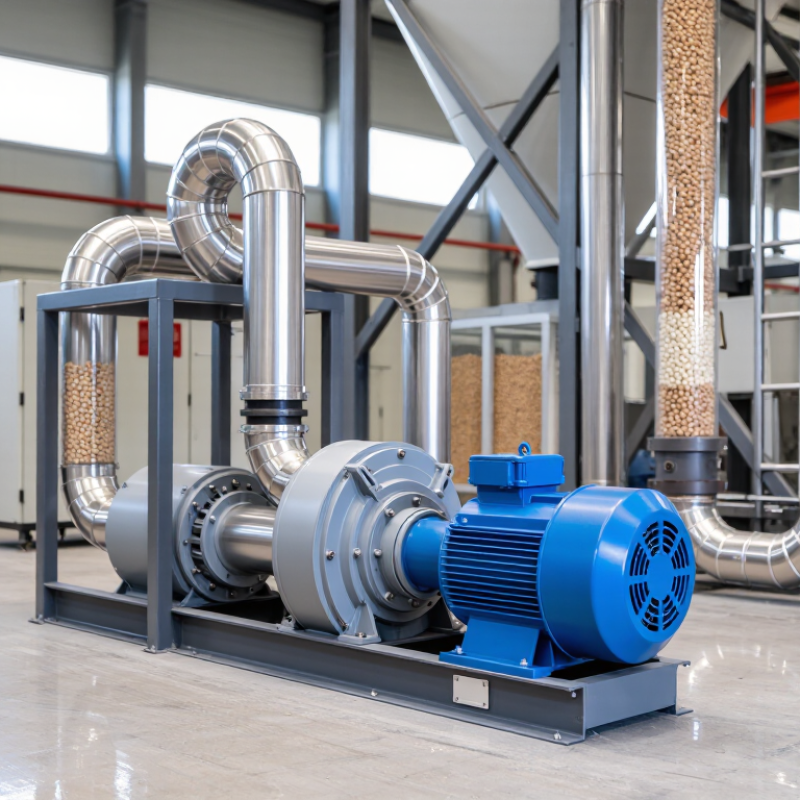
What Is a Pneumatic Conveying Blower and How Does It Move Bulk Material?
A pneumatic conveying blower moves dry bulk material by creating airflow and a pressure difference inside a pipe. The air pushes material from a feed point toward a destination, where a filter or receiver separates solids from air. Think of powder entering a sealed line, traveling through bends, then dropping into a storage vessel. Simple in principle. Sensitive in practice.
In dilute-phase conveying, fast-moving air suspends particles through the pipeline. Dense-phase systems move material more slowly, often in concentrated plugs. The right approach depends on particle size, bulk density, abrasiveness, route length, and required throughput. A blower may push air from the inlet or draw it from the receiving end. Poorly matched airflow can cause blockages, excessive wear, or damaged product.
Energy deserves attention. The U.S. Department of Energy’s Improving Compressed Air System Performance sourcebook reports that compressed-air systems account for about 10% of electricity use in U.S. manufacturing. That figure covers systems broadly, not conveying blowers alone. Still, it shows why leaks, filters, and operating pressure matter. A practical check is to compare actual material flow and pressure with design conditions. Real plants change; the original settings may no longer fit.
Which Blower Types Suit Different Conveying Systems?
Choosing a blower starts with the conveying method, not a catalogue rating. Dilute-phase systems move material quickly through a steady air stream. Rotary-lobe blowers often suit these low-pressure duties, especially where airflow stays fairly constant. They are straightforward to maintain, but can become noisy and less efficient when pressure rises. That matters.
For longer lines or higher pressure demands, a positive-displacement blower may provide the needed airflow against changing resistance. Dense-phase systems use slower material movement and higher pressure, so blower selection must match the conveying vessel and control sequence. A rotary-lobe unit may work in some installations, while other systems need a different pressure range. Check the full operating curve, not just the maximum pressure. A number on a nameplate rarely tells the whole story.
Centrifugal blowers can suit dilute-phase systems that need high airflow at relatively modest pressure. Multistage designs can serve applications with greater pressure requirements, while dry screw blowers may offer a useful balance of pressure, efficiency, and reduced pulsation. Not always. Compare air volume, line length, pipe bends, material density, and filter losses under real operating conditions. Fine powders and fragile granules behave differently, even in similar pipes. A practical test with the actual material can expose assumptions that calculations miss. The best choice is the one that maintains stable conveying without excessive heat, noise, or energy use.
What Factors Determine the Best Blower for a Bulk Material?
2026 Best Pneumatic Conveying Blower for Bulk Material?
What Factors Determine the Best Blower for a Bulk Material?
The right blower depends on the material and the conveying line, not just the required airflow. Start with particle size, bulk density, moisture, and temperature. Fine, dry powder behaves differently from damp granules. A handful of material may reveal clumping or dust, but it cannot replace a representative test. Fragile particles may break under high velocity. Abrasive material can wear pipes and fittings faster than expected.
Next, match blower pressure and air volume to the route, throughput, and conveying method. A long line with several bends creates more resistance than a short, straight run. Dense-phase conveying often needs higher pressure, while dilute-phase systems rely on faster airflow. Check the blower’s operating curve at the actual site conditions, including altitude and inlet temperature. A catalog rating alone is not enough.
Consider energy use, filtration, noise, and maintenance access, too. Keep the filter clean, and allow room to inspect it. Undersized equipment may struggle to meet production targets; oversized equipment can waste power or damage sensitive material. There is no universal winner. I would verify the material data and line losses before choosing, then review performance after startup. Estimates can be wrong. That is worth admitting.
How to Compare Blower Performance, Efficiency, and Reliability in 2026
For a pneumatic conveying blower, compare delivered airflow at the pressure your pipeline actually needs, not the headline flow rate. Request performance curves across the operating range. A blower sized only for peak demand may waste energy during ordinary shifts. Check how the curve responds to pipe length, bends, filter resistance, and material loading. Small details matter. Dense pellets and fine powders do not behave alike; test with representative material when possible.
Efficiency is more than motor rating. Compare power consumption at the expected duty point, then consider variable-speed control and heat management. Record air pressure and temperature during a trial, and watch for changes as filters collect dust. Reliability depends on bearings, seals, cooling, and access for routine service. Ask how often inspections are recommended and whether parts are straightforward to replace. A quiet unit is not automatically a dependable one. Nor does a low purchase price prove low lifetime cost. I would leave room for uncertainty: conveying systems change, and a tidy calculation can miss real-world variation. Listen for unusual vibration, inspect connections for leaks, and review operating data after the first weeks.
How to Install, Operate, and Maintain a Conveying Blower Safely
A pneumatic conveying blower should be installed on a level, rigid base that limits vibration. Check the foundation, fasteners, and shaft alignment before connecting the inlet and discharge lines. Pipework must be supported independently; heavy ducts can strain the blower casing. Fit guards over moving parts, and confirm that pressure relief devices and filters match the system design. Keep the inlet clear of dust buildup and foreign objects. Never guess. Use the equipment manual and have a qualified technician verify clearances and electrical connections before startup.
Start the blower with the conveying line configured as specified by its manufacturer. Listen for unusual rattling, then check pressure, airflow, temperature, and vibration against the equipment’s operating limits. Stop it if readings change sharply or a hot smell appears. In practice, crews sometimes rush this check when production is waiting. That is a poor trade. Isolate power and relieve system pressure before inspection or maintenance. Clean filters on schedule, inspect belts and couplings for wear, and tighten loose supports. Keep a simple log of readings and repairs; small trends are easier to catch on paper than by memory. Recheck guards after service. Keep it clean.
Typical Pneumatic Conveying Air Velocities
Indicative ranges for dilute- and dense-phase conveying. Actual velocity depends on the material, pipeline, and system design; use a qualified system calculation to set operating limits.
Safe operation: monitor conveying pressure and airflow, and avoid operating below the system’s validated minimum conveying velocity. Before inspection or maintenance, stop the blower, isolate energy sources, release stored pressure, and follow site lockout procedures.
 (780) 669-9420